

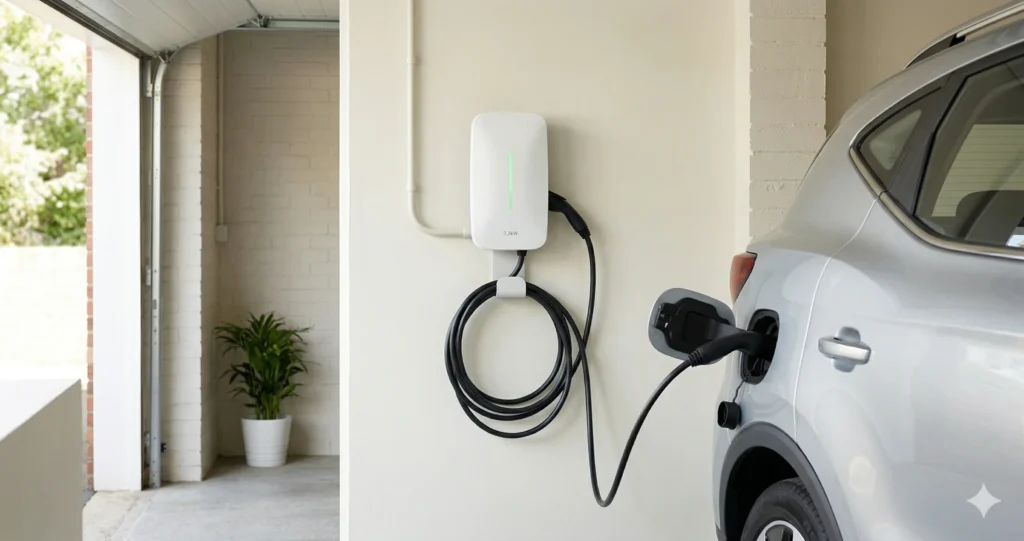

If you own a Tata Nexon EV or Tata Punch EV and rely on the bundled portable 3.3kW charger, your 40–45kWh battery is taking over 14 hours to top up from empty every night. That is not a charging strategy — that is a risk. You are starting every commute day on a half-filled battery.
Upgrading to a dedicated 7.2kW AC wall-box charger cuts that charging window to under 6 hours, letting you plug in after dinner and wake up to a full battery. However, that upgrade is not a simple ₹3,000 Amazon order. In Tamil Nadu, the real-world installed cost — including hardware, heavy-duty copper cabling, MCB/RCCB switchgear, and a mandatory TANGEDCO sanctioned load upgrade — lands between ₹35,000 and ₹55,000. Some apartments will exceed ₹60,000.
Quick Numbers — What You Are Actually Paying For
| Cost Component | Estimated Range (2026) | Notes |
|---|---|---|
| 7.2kW RFID Wall-Box | ₹20,000 – ₹45,000 | Hardware cost; price varies by brand (e.g., Exicom vs. Tata Power). |
| 40A MCB + RCCB Type B | ₹12,000 – ₹18,000 | Essential Safety: Type B DC-leakage protection is required for EVs. |
| TANGEDCO Load Upgrade | ₹3,000 – ₹12,000 | Utility fee to increase sanctioned load (typically to 10kW+). |
| 6 sq.mm Copper Cabling | ₹180 – ₹250/m | 2-core FR (Flame Retardant) cable; distance varies by parking spot. |
| Licensed Installation | ₹4,000 – ₹8,000 | Labor for mounting, wiring, and safety certification. |
| Apartment Transformer | Variable / Split | Note: Collective upgrade cost if the building’s main transformer is maxed. |
| Total Installed Cost | ₹45,000 – ₹75,000+ | Final Estimate: Includes safety switchgear and standard installation. |
The Hardware Costs
2a. The Charger Unit
A 7.2kW single-phase Level 2 EVSE provides controlled AC power to an EV’s onboard charger, which converts it to DC for the battery. This method, typically using 230V at 32A, reduces thermal stress and is the preferred method for long-term battery health compared to high-power DC fast charging.
Reliable brands available in India (2026):
7.5kW Smart EV Charger (Aveo Pro)
Portable & Wall-Mount: Highly versatile 32A Type-2 charger with adjustable power, 5m TPU cable, and a 3″ display. Certified with ARAI, CE, and TUV for the Indian market.
View on Amazon India7.2kW HyperCharge Portable Unit
IP67 Waterproof: A rugged 32A charger specifically designed for the Indian monsoon. Features a large LCD, 6m cable, and built-in MCB protection for maximum flexibility.
View on Amazon India7.5kW Smart Pro Charger
App & RFID Ready: Premium smart features including load balancing, app control, and RFID authentication. Includes high-end safety features like Emergency Switch and Anti-Theft.
View on Amazon IndiaPowerPod Lite 7.4kW
No-App Simplicity: A robust plug-and-play wall box with RFID access. Focused on durability and high-grade leakage protection, gaining massive popularity in South India.
View on RIOD IndiaEZ Home Wallbox 7.2kW
Official OEM Support: The standard choice for Tata EV owners. Offers nationwide service coverage, stable app connectivity, and seamless integration with the EZ Charge ecosystem.
View Official StoreSmart Spin Air 7.5kW
Alexa Enabled: A tech-forward charger with 4G/Bluetooth connectivity and voice control support. Frequently cited as a top-tier upgrade for modern Indian EVs.
View Official StoreNectar 7.4kW Smart Home
Auto Cut-Off: Premium features include load balancing and automatic session termination. Highly rated for its user-friendly app and robust build quality.
View on Statiq2b. The Switchgear — Do Not Cut This Corner
Your charger is only as safe as the electrical panel protecting it. A 7.2kW charger drawing a sustained load at 32A requires two specific safety devices wired before the charger feed:
- 40A Miniature Circuit Breaker (MCB):
Protects your home wiring against overcurrent and short circuits. It must be a C-Curve breaker rated for continuous 32A draw.- Estimated Cost: ₹800 – ₹1,500
- RCCB Type B (Residual Current Circuit Breaker):
This is non-negotiable for EV charging. Standard Type AC or Type A RCCBs (used for lights and fans) cannot detect the smooth DC leakage currents that EV batteries produce. Skipping this for a cheaper unit is a documented fire and electrocution risk.- Estimated Cost: ₹12,000 – ₹18,000
Acti9 xC60 40A DP MCB
Core Circuit Safety: A 40A Double Pole (DP) C-Curve MCB is essential for 32A home chargers. It protects your house wiring against sustained high-load overheating and short circuits.
View on Amazon IndiaActi9 iID Type B-EV RCCB
DC Leakage Protection: Non-negotiable for safety. Detects smooth DC leakage that standard RCCBs miss. Use this if your charger does not have built-in DC protection to prevent electric shocks.
View Industrial ListingActi9 xID 40A 30mA RCCB
AC Leakage Safety: A high-quality standard RCCB. **Note:** Only use this budget option if your EV charger manual specifically confirms it has “Internal 6mA DC Leakage Detection.”
View on Amazon IndiaLifeLine Plus 6 sq.mm Cable
High-Heat Conductor: 6 sq.mm HRFR (Heat Resistant) copper wiring is the Indian standard for 7.4kW chargers to handle 8+ hours of continuous power without melting.
Check Price on AmazonOVR T2 40-275 Surge Arrester
Electronic Safeguard: Protects the charger’s logic board from voltage spikes and lightning. Highly recommended for independent houses and areas with frequent power fluctuations.
View Official StoreEuro 2 40A DP Isolator
Positive Isolation: A robust thermoplastic disconnector with clear ON/OFF status. Provides a dedicated physical switch to cut power for maintenance without affecting the rest of your home.
View on Amazon IndiaCritical Safety Note
Cutting corners on wiring gauge or switchgear to save ₹2,000 risks a house fire or electrocution. A certified electrician who argues against a Type B RCCB is an electrician you should avoid.
The TANGEDCO Sanctioned Load Upgrade — The Bureaucracy You Cannot Skip
This is where most Tamil Nadu EV buyers get stuck three weeks after their charger arrives. They plug in, the charger trips the main breaker, and they realise their 4kW single-phase connection is nowhere near enough.
The Engineering Reality: A 7.2kW charger running at full capacity draws approximately 32A. In Tamil Nadu, any load above 4kW requires a three-phase upgrade. Factor in the mandatory 1.25x safety headroom, and you need at least 9kW of sanctioned load dedicated to the charger alone. If you don’t upgrade officially, TANGEDCO’s new systems will detect the surge and automatically bill you for a load enhancement after three such instances.
What Is Your Current Sanctioned Load?
Most standard Tamil Nadu domestic connections fall into these categories:
| Connection Type | Typical Sanctioned Load | Can Run 7.2kW Fast Charger? |
|---|---|---|
| Single-Phase (1-2 BHK) | 2 kW – 4 kW | No — Upgrade to 3-Phase mandatory. |
| Three-Phase (3 BHK+) | 5 kW – 7 kW | No — Will trip the main breaker; load enhancement required. |
| EV-Ready (Upgraded) | 12 kW – 15 kW | Yes — Safely covers the charger + household ACs/appliances. |
If your sanctioned load is 4kW (Single-Phase) and you plug in a 7.2kW charger, you aren’t just “overloading”—you are attempting to pull nearly double the capacity of your main fuse. Even with a 7kW Three-Phase connection, running a 7.2kW charger plus two 1.5-ton ACs will trip your TANGEDCO breaker instantly.
The TANGEDCO Load Extension Process (Step-by-Step)
TANGEDCO has fully digitised the application process for LT domestic connections. Do not visit a physical office; all tracking and payments are online.
- Access the Portal: Visit the TANGEDCO Online Application Portal and select ‘Load Addition / Reduction’.
- Login: Enter your Service Connection (SC) Number and your registered mobile number. Ensure your Aadhaar is already linked to the service.
- Application Details: Enter your proposed load (e.g., upgrading from 4kW to 12kW). You will need to upload:
- Latest Electricity Bill receipt.
- Ownership Proof (Sale Deed/Patta) or Latest Property Tax receipt.
- Test Report (Form-4): Signed by a Licensed Electrical Contractor (this is critical for EV upgrades).
- Initial Payment: Pay the registration and testing fees online. Once paid, your application is officially registered.
- Technical Sanction:
- For mere load addition, an estimate is usually prepared within 3 working days.
- If a meter upgrade or line extension (shifting to 3-phase) is needed, the estimate takes up to 15 days.
- Final Payment & Effect: Pay the “Estimate Charges” (Development Charges + Security Deposit) online within 15 days of the sanction.
- Completion: TANGEDCO will install the new meter/equipment, and your next bill will reflect the new enhanced sanctioned load.
What Does TANGEDCO Actually Charge for a Load Upgrade?
TANGEDCO’s fee structure for load additions under LT domestic (LT-IA) includes a combination of registration fees, service line estimate charges, and proportional infrastructure costs. Indicative costs for typical EV-driven upgrades in Tamil Nadu in 2026:
| Upgrade Scenario | Estimated TANGEDCO Charges | Timeframe |
|---|---|---|
| 2kW → 8kW(simple wiring upgrade, no line extension) | ₹20,000 – ₹25,000 | 3–15 working days |
| 4kW → 10kW(possible service line upgrade needed) | ₹22,000 – ₹32,000 | 15–30 working days |
| 2kW → 10kW(full infrastructure upgrade in apartment block) | ₹35,000 – ₹55,000 | 30–45 working days |
Important: These are indicative ranges based on current TANGEDCO schedule-of-rates and field reports from Tamil Nadu consumers. Actual charges depend on your specific location (Overhead vs. Underground cabling), feeder infrastructure, and distance from the nearest distribution transformer. Always get a formal written estimate from TANGEDCO via the official portal before proceeding.
Before You Spend ₹50,000 — Do the EV Math First
Installing a home fast charger is a ₹50,000–₹75,000 infrastructure decision. Before you commit, make sure that the economics of EV ownership work for your specific commute, fuel costs, and driving pattern in Tamil Nadu.
Stop Guessing. Do the Math.
Before you spend ₹50,000+ on a fast charger and grid upgrades, make sure the overall EV math actually works for your specific daily commute and local electricity slab.
Calculate Your EV Savings vs Petrol (Free Tool)Our EV vs Petrol TCO Calculator factors in your daily kms, TANGEDCO electricity slabs, petrol prices, car price differential, and maintenance to give you a real rupee-per-km comparison. Do not make a ₹50,000 infrastructure bet on guesswork.
Installation & Cabling — The Costs Nobody Warns You About
Every Tata, MG, and Hyundai dealership in Chennai will offer ‘free installation’ of your home charger. Read that fine print carefully. Free installation typically means the first 5 to 10 metres of cable run from your electrical panel to the wall-box mounting point. If you live in an apartment, that distance is almost never 10 meters.
The Cable Cost Calculation
A 7.2kW charger drawing 32A requires a minimum of 6 sq.mm cross-section copper core cable. Standard 4 sq.mm cable is not adequate for this sustained load — it will run hot, degrade, and eventually create a fire risk. Insist on 6 sq.mm copper. This is an engineering specification, not a upsell.
| Cable Run Scenario | Estimated Length | Math (@ ₹260/m avg) | Total Cable Cost |
|---|---|---|---|
| Independent house, meter box near garage | 8 – 12 m | ₹260 × 10m | ₹2,200 – ₹3,200 |
| Apartment, meter box 2 floors up | 18 – 25 m | ₹260 × 22m | ₹4,800 – ₹6,800 |
| Apartment, basement parking + vertical run | 28 – 40 m | ₹260 × 34m | ₹7,500 – ₹10,500 |
| Ground-floor commercial/villa, long run | 40 – 60 m | ₹260 × 50m | ₹11,000 – ₹16,000 |
At current market rates in Tamil Nadu, 6 sq.mm copper core armoured cable runs between ₹240 and ₹290 per metre. These prices are sourced from local electrical wholesale suppliers (Crompton, Havells wire division) and are consistent with 2025–2026 Schedule of Rates data from Tamil Nadu PWD electrical wiring cost estimates.
Pro Tip
Ask your electrician specifically for ISI-marked 6 sq.mm copper cable. Reject any aluminium cable substitution — aluminium has lower conductivity, expands and contracts differently at joints under thermal load, and carries a significantly higher fault risk at sustained high amperages.
Conduit, Conduit Boxes & Labour
The cabling must run through heavy-duty PVC or steel conduit — not bare cable stapled to your wall. Conduit and junction boxes add ₹800 to ₹2,500 depending on cable run length. A licensed electrician’s day rate in Chennai for this class of work is ₹3,000 to ₹8,000. This higher rate is necessary because you require a Licensed C-Certificate Contractor who can provide the mandatory Form-4 Test Report for your TANGEDCO load upgrade.
