


Your production is slowing down. Machines are busy but still not getting work done fast enough. Or maybe your team is working hard, but orders keep piling up in one area. This happens because something is holding you back. That one thing is called a constraint.
The good news? There is a simple way to find it and fix it. It is called the Five Focusing Steps. This method comes from a man named Dr. Eliyahu Goldratt. He created it to help businesses understand what is actually slowing them down.
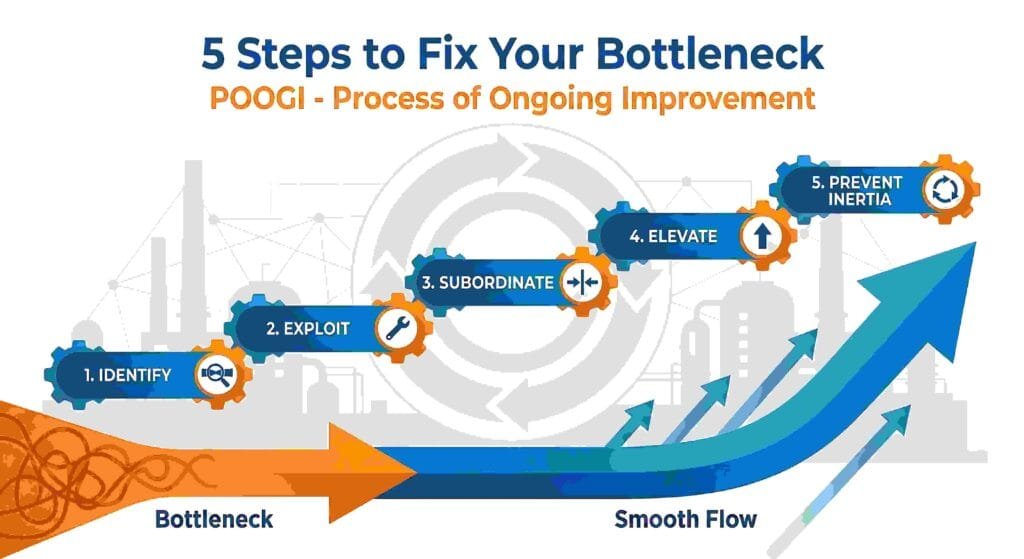
The Five Focusing Steps are also called POOGI. That stands for “Process of Ongoing Improvement.” It is not a one-time fix. It is a way of continuously getting better. Once you fix one problem, you move to the next one.
This guide explains each step in simple words. You will learn what to look for, how to fix it, and when to spend money on bigger solutions. By the end, you will know exactly how to use this method in your own business.
What Are the Five Focusing Steps?
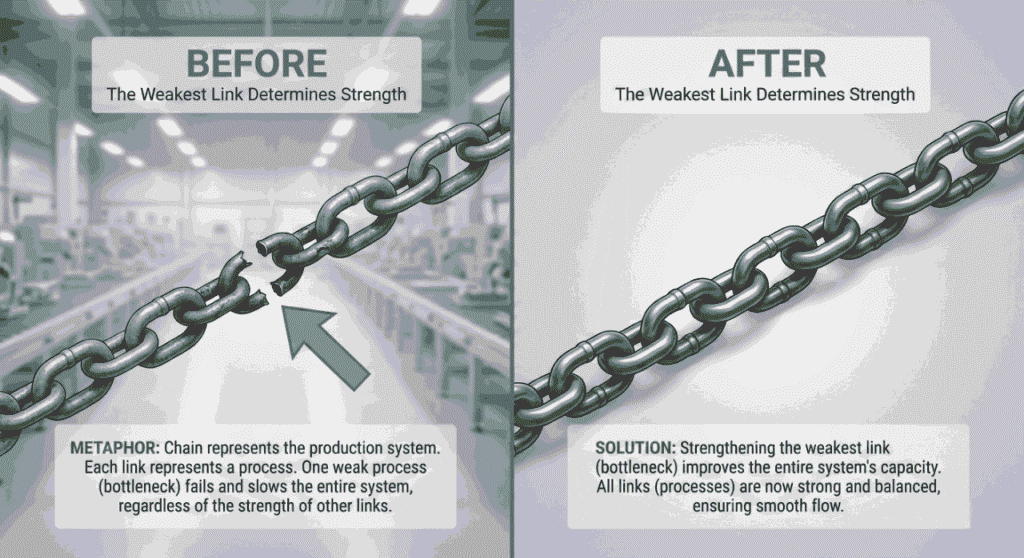
Think of your business like a chain. A chain is only as strong as its weakest link. If one link breaks, the whole chain breaks. It does not matter how strong all the other links are.
Your business works the same way. One process, one machine, or one person is probably holding back everything else. That weak link is your constraint. The Five Focusing Steps help you find it and make it stronger.
Here are the five steps in order:
Step 1: Identify – Find what is slowing you down.
Step 2: Exploit – Get the most from what you already have.
Step 3: Subordinate – Make everything else support that bottleneck.
Step 4: Elevate – If needed, invest money to expand it.
Step 5: Prevent Inertia – Keep the process going. Do not stop when you fix one problem.
Once you finish all five steps, you start over at Step 1. There will always be a new constraint. That is how continuous improvement works.
Step 1: Identify the System’s Constraint
Before you can fix something, you need to find it. This is the most important step. Getting this wrong means you will waste time on the wrong problem.
A constraint is simply something that stops you from doing more work. It could be:
- A Machine: An old machine that is slower than the others. Maybe it breaks down often. It produces half the output of other machines.
- People: You do not have enough people with the right skills. Or one person does all the important work, and they cannot keep up with the demand.
- A Process: Your approval process takes too long. Paperwork gets stuck. Information is not clear. Meetings slow things down.
- Materials: You run out of raw materials. Suppliers are slow. You cannot get what you need when you need it.
- Company Rules: A policy says you must do something a certain way. That rule made sense in the past. Now it slows everything down.
- Market Demand: This is different. Sometimes you actually produce more than customers want. In this case, you do not have a production problem. You have a sales problem.
How to Spot Your Constraint
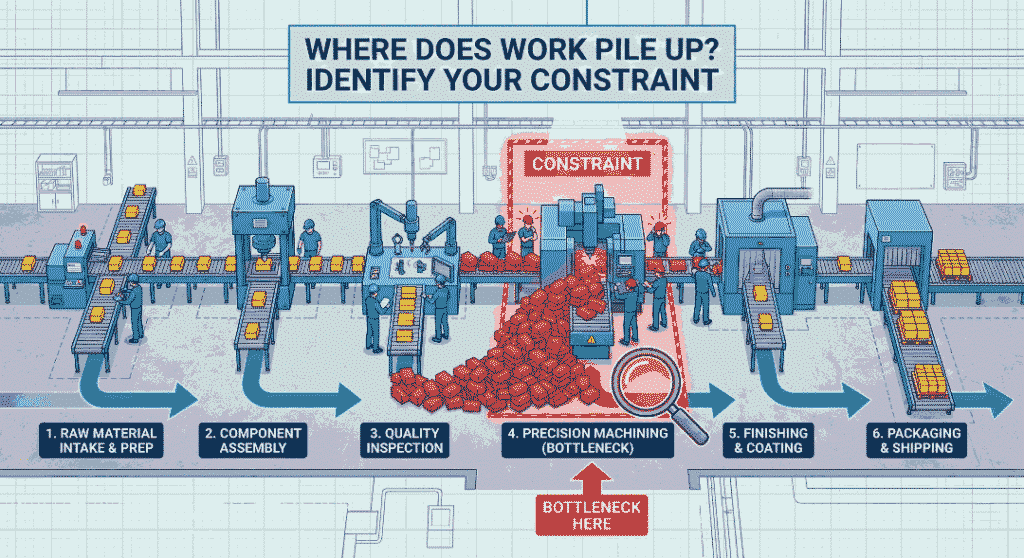
Watch for piles of work. Walk your production area. Where does work pile up waiting? That usually shows where your bottleneck is. If customers are waiting for orders in front of your quality check area, the quality check is probably your constraint.
Talk to your people. Ask your team where things get slow. They see problems every day. They know where the delays happen.
Look at numbers. Which process takes the longest? Which machine has the lowest output? Which department misses deadlines? These numbers show you the weak link.
Use simple measurements. Look at overall equipment effectiveness (OEE). This tells you how well each machine is performing. The machine with the lowest OEE might be your constraint.
The key is finding the ONE thing that matters most. You should not focus on ten problems. One constraint. Focus on that first.
Step 2: Exploit the Constraint
Now you found the problem. Do not immediately spend money on a new machine or hire new people. First, get everything possible out of what you already have.
“Exploit” means “squeeze.” Get as much production as you can from your current constraint without spending a lot of money.
Real Example
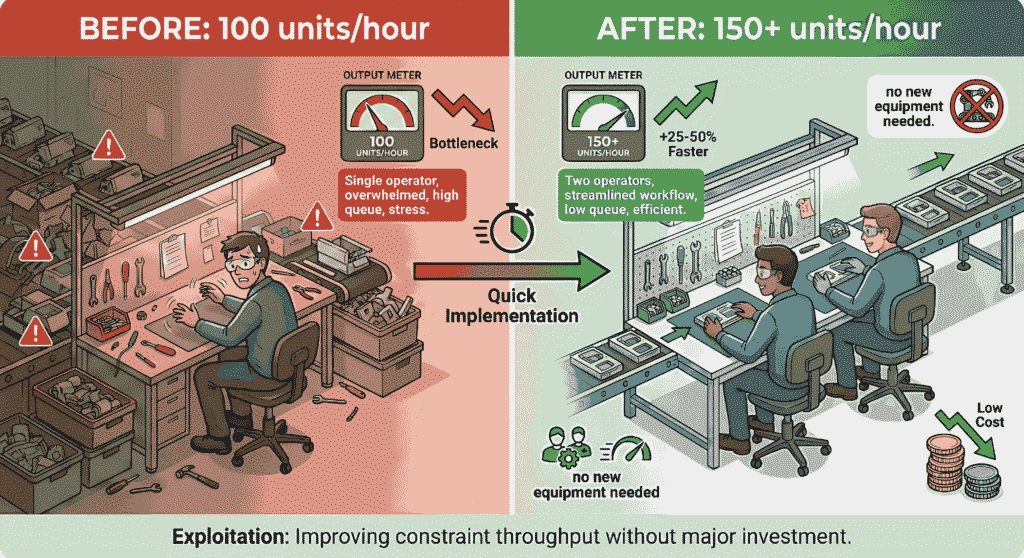
Imagine you have a quality inspection station. It checks 100 units per hour. The assembly line produces 150 units per hour. The inspection is your constraint.
How do you exploit it without spending big money?
- Add another inspector. Bring in someone to help. This does not cost much. You just need one more person. Now inspection can handle 200 units per hour. Problem partly solved.
- Remove unnecessary steps. Maybe inspectors check things that do not really matter. Cut those checks out. Inspect only what is important.
- Train better. Teach inspectors faster techniques. Show them how to check quality more quickly without missing problems.
- Fix the workspace. Better lighting helps inspectors see faster. Better desk height means less wasted movement. These small things add up.
- Improve communication. Make sure inspectors never wait. Materials should arrive smoothly. They should know what to do before they start each inspection.
Results to Expect
This step usually gives you 10 to 20 percent improvement. Sometimes more. And you do not need a large budget. You just use your current resources better.
This is where you find quick wins. These wins prove that you are on the right track. They also give you proof to show your boss that this method works.
Step 3: Subordinate Everything Else
Here is where most companies make a mistake. They think every machine should run at full speed all the time. They think every department should be busy constantly. This seems smart, but it is not.
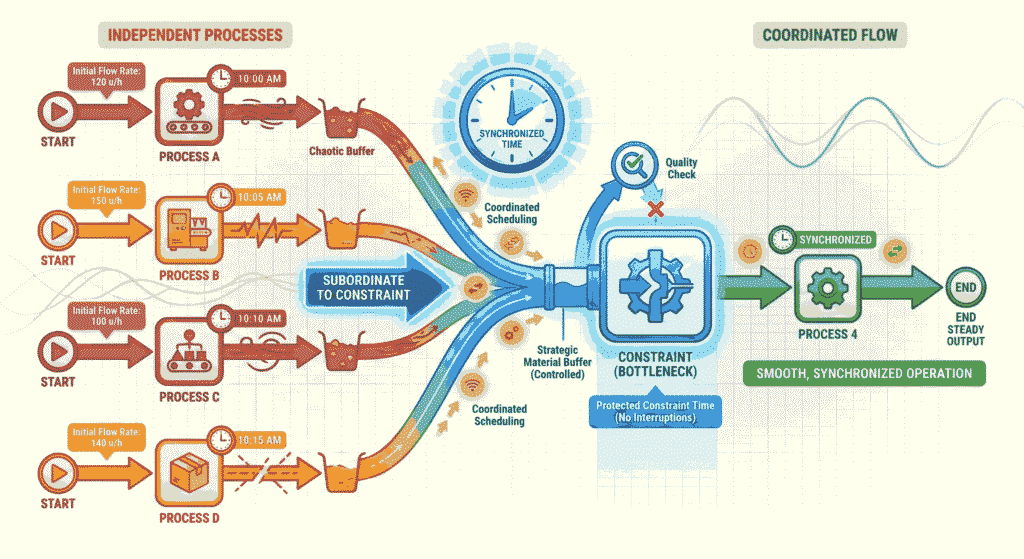
Subordinate means aligning everything to support your constraints. Let other processes slow down if needed. The goal is not to keep everything running. The goal is to move more finished products out the door.
Why This Matters
Imagine upstream processes produce material faster than your constraint can handle. Work piles up. You use more space to store it. Machines are busy, but nothing gets completed. More inventory means more money tied up that you cannot use.
Now imagine everything is timed to match your constraint. Material arrives smoothly. Nothing waits long. Nothing backs up. Everything flows.
Real Example
Think of a camera assembly line. Making lenses takes 60 minutes. Making sensors takes 30 minutes. Assembly takes 45 minutes.
If you run both lens and sensor production at full speed, sensors pile up waiting for lenses. You have wasted money sitting in storage. Capital is tied up.
Instead, start lens production first. Wait 30 minutes. Then start sensor production. Now both components arrive at assembly around the same time. Smooth flow. Less waiting. Less waste.
What Subordination Looks Like
- Adjust schedules. Slow down processes that run faster than your constraint. Start them later so they deliver right when needed.
- Maintain buffers. Keep some extra material just before the constraint. Not too much. Just enough so the constraint never waits.
- Add quality checks upstream. Catch problems before they reach the constraint. This prevents bad materials from going into your bottleneck.
- Give constraint workers priority. Best staff, best tools, no interruptions. Constraint operators get trained people and uninterrupted focus time.
- Protect the constraint. Meetings should not take constrained workers away. They should not do other jobs. Constraint time is precious.
Step 4: Elevate the Constraint
After you are exploited and subordinated, sometimes the constraint still limits your growth. The business is growing. Demand is increasing. You have done everything you can with current resources.
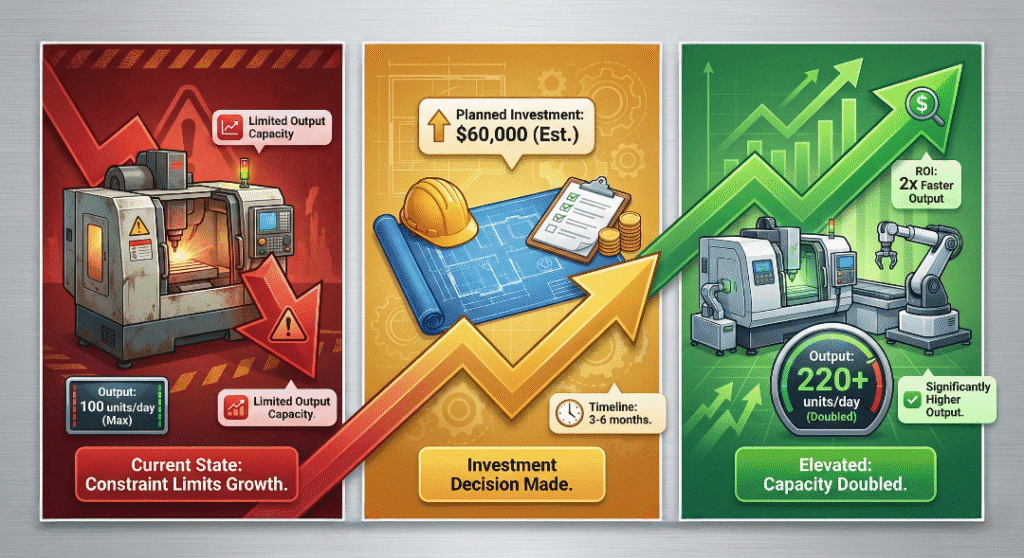
Now it is time to elevate. That means invest money to expand capacity.
When to Elevate
Wait for the right time. Do not elevate immediately. Make sure you have really squeezed everything from exploitation and subordination first. Too many companies buy equipment when the real problem is poor scheduling.
The constraint still limits you. You have eliminated waste. You have optimized processes. But you still cannot meet demand. Now elevation makes sense.
The money makes sense. Calculate if the improvement will earn back the investment. If you spend $50,000 on a new machine, but it only saves $100 per month, do not do it. If it saves $5,000 per month, that investment pays for itself in 10 months. That makes sense.
What Elevation Looks Like
- Buy equipment. Get a faster machine. Duplicate an existing machine. Add automation.
- Hire more people. Bring on more staff for that department. But hire for the constraint only. Do not hire everywhere.
- Upgrade technology. Implement software that helps the constraint run faster. Update old equipment.
- Expand space. Sometimes the constraint needs more room to work.
- Outsource. Send some work outside to reduce demand on your internal constraint.
Real Example
Your inspection station improved from 100 to 150 units per hour using exploitation. But you need 200 per hour to meet customer demand. You buy a second inspection machine for $40,000. Now you can handle 300 units per hour.
Suddenly, something else becomes slow. Maybe assembly. Or packaging. Your constraint shifted. Now you repeat the entire process with the new constraint.
Step 5: Prevent Inertia
This step is a warning. Do not stop. Do not celebrate and then do nothing.
What is inertia? It is when organizations stop improving. They break one constraint and then freeze. They do not want to change again. They like the status quo.
The New Constraint Always Emerges
When you fix one bottleneck, something else becomes slow. This is not failure. This is progress. You removed one problem. Now you see the next one.
The best organizations never stop. They keep applying the Five Focusing Steps. They move from constraint to constraint. They continuously improve.
How to Prevent Inertia
- Keep people engaged. Tell your team that we found one bottleneck. Now we will find the next. Make it normal to keep improving.
- Celebrate, but keep moving. Yes, celebrate the win. Show the results. Then say, “Now let us find what is slowing us down next.”
- Use measurements. Track where work is piling up now. Where are delays happening? Start looking for the new constraint.
- Go back to Step 1. Repeat the entire process. Identify. Exploit. Subordinate. Elevate. Keep the cycle going.
Why This Matters
Companies that do this become stronger every year. They get faster. They reduce costs. They meet deadlines better. Customers like them more. They make more money.
Companies that stop? They stay the same. Their competitors improve faster. Eventually, competitors take their business.
Real-World Success Stories: How Industry Leaders Use TOC
You don’t have to guess if this works. Major global companies have used the Five Focusing Steps to turn around financial losses and dominate their markets. Here is the evidence.
Case Study 1: Mazda’s Manufacturing Turnaround
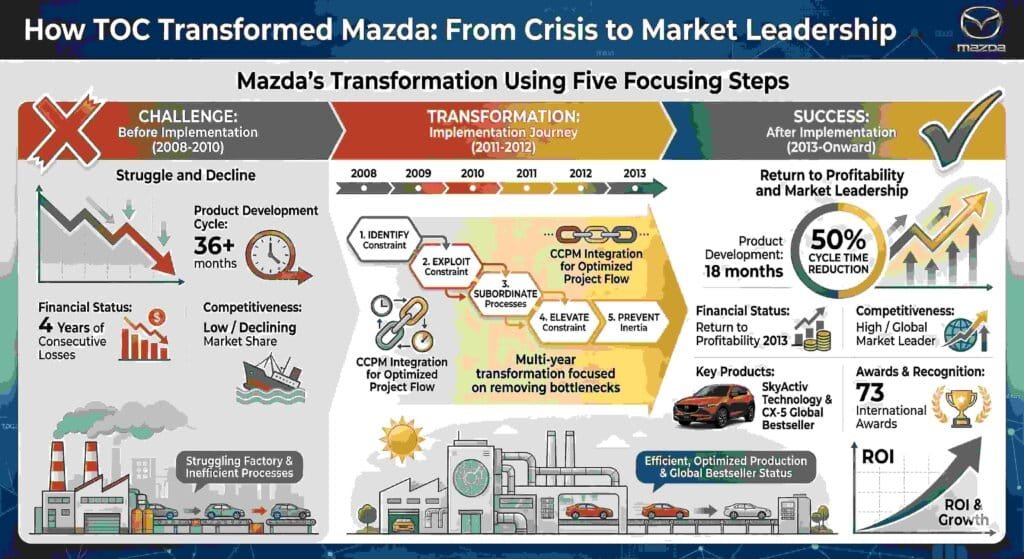
In the late 2000s, Mazda was facing a crisis. They were posting financial losses and could not develop new cars fast enough to compete with Toyota and Honda. Their constraint was not the factory floor—it was their product development pipeline.
- Step 1 – Identify: Mazda realized their constraint was the “testing and validation” phase. Engineers were multitasking across too many projects, causing massive delays.
- Step 2 – Exploit: They didn’t hire more engineers immediately. Instead, they implemented a TOC method called Critical Chain Project Management. They stopped multitasking. Engineers worked on one task until it was finished.
- Step 3 – Subordinate: All management schedules were aligned to support the engineering teams. Non-critical meetings were cancelled. If an engineer needed a decision, they got it immediately.
- Step 4 – Elevate: Only after fixing the flow did they invest in new simulation technology to speed up testing.
- Step 5 – Prevent Inertia: They applied this new speed to their entire engine production line.
The Evidence:
- Result: Mazda cut their product development lead time by 50% (from 36 months to 18 months).
- Outcome: This speed allowed them to launch the SkyActiv technology and the CX-5, which became a global bestseller.
- Financials: By 2013, Mazda returned to record-breaking profitability, largely credited to this operational shift.
Case Study 2: Delta Airlines Maintenance (MRO)
Delta’s TechOps division had a major problem. Their maintenance turnaround time (TAT) for engines was too long. Engines sitting in the shop meant planes were grounded, costing the airline millions.
- Step 1 – Identify: The constraint was the “parts repair” department. Engines were stripped down, but mechanics spent days waiting for specific repaired parts to return.
- Step 2 – Exploit: Delta reorganized the parts flow. They prioritized repairing the specific parts that were holding up the most engines, rather than just repairing whatever was easiest.
- Step 3 – Subordinate: The entire logistics team changed their schedule. Parts were delivered to mechanics exactly when needed, so mechanics never walked to fetch inventory.
- Step 4 – Elevate: They invested in a “kitting” system where all parts for a specific task were boxed together before the mechanic even started the job.
The Evidence:
- Result: Delta reduced engine maintenance turnaround time from 100+ days to roughly 65 days.
- Outcome: They eliminated the need to lease spare engines, saving $100 million per year.
- Efficiency: They became so efficient that they started fixing engines for other airlines as a new revenue stream.
Comparison: Before vs. After TOC Implementation
Here is what the operational pipeline looks like when you apply these steps.
| Process Step | Traditional Pipeline (Before TOC) | Optimized Pipeline (After TOC) |
|---|---|---|
| Scheduling | Push system: Start every job as soon as possible. | Pull system: Start jobs only when the constraint is ready. |
| WIP Inventory | High: Piles of unfinished work everywhere. | Low: Only essential buffers before the bottleneck. |
| Focus | Local Efficiency: Everyone tries to be 100% busy. | System Flow: Non-constraints have idle time; flow is smooth. |
| Problem Solving | Firefighting: Fixing every problem that pops up. | Targeted: Fixing only the problems that affect the constraint. |
| Outcome | High chaos, long lead times, missed deadlines. | Predictable delivery, short lead times, higher profit. |
Quick Action Plan

Use this simple checklist to get started:
Week 1: Walk your facility. Look for where work piles up. Talk to your team. Find your constraint.
Week 2: Make a list of ways to exploit it. Things you can do without big money. No major equipment purchase. Just optimization.
Week 3: Start the exploitation. Test your ideas. Measure the results.
Week 4: Adjust schedules and processes to subordinate everything to the constraint. Make sure nothing else gets in its way.
Month 2: If growth continues and constraint still limits you, plan elevation. Get quotes for equipment or additional staffing.
Month 3: If you elevate, implement the changes. Monitor results.
Month 4: Find the new constraint. Do not stop. Keep improving.
Key Points to Remember
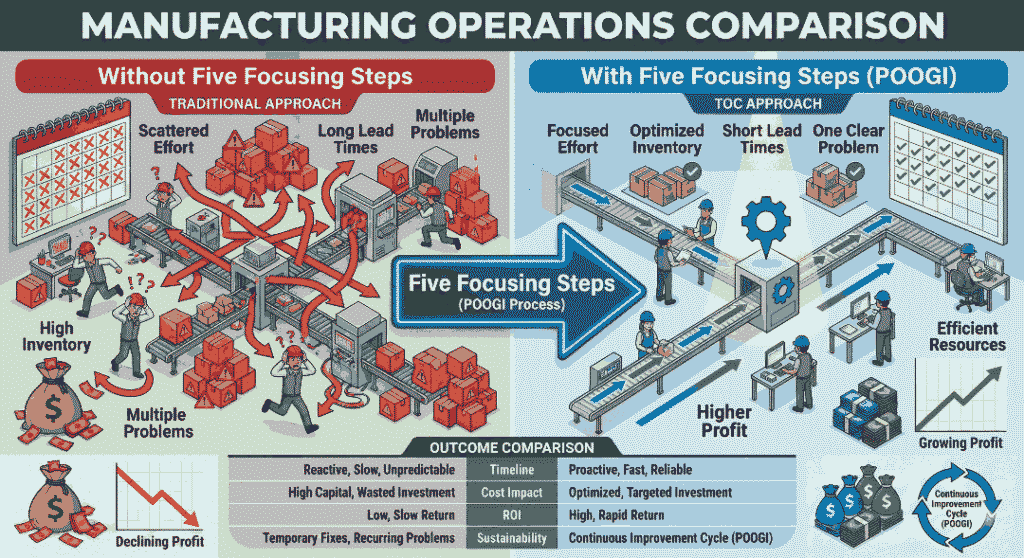
Focus; do not spread thin. Most companies try to improve everything at once. This rarely works. Choose one constraint. Improve that. Then move to the next.
The process is continuous. You never finish. Once you fix one problem, another appears. This is normal. It means you are improving.
Simple is better. You do not need complex software or consultants to start. Walk your facility. Talk to your people. Use basic measurements. Start exploiting.
Results come fast. If you identify the real constraint, exploitation usually gives 10 to 20 percent improvement within weeks. Not years.
Do not blame people. The constraint is usually not because workers are lazy. Usually it is a process, a machine, or a system design problem. Fix the system. Do not blame the person.
How long does the entire POOGI process take?
Can I use these steps in my industry, or is this only for manufacturing?
My company has multiple constraints. What do I do?
How much money will I need to improve using these steps?
What if I identify the constraint wrong? What if I focus on the wrong thing?
Is this the same as Lean manufacturing?
What happens when I fix one constraint? Will problems just keep appearing forever?
How do I know if I am doing this right?
Connection to Your Broader TOC Strategy
These Five Focusing Steps are the foundation of continuous improvement. They work best as part of your overall Theory of Constraints strategy. For a comprehensive understanding of TOC and how it applies to your entire operation, including software solutions and advanced implementations, read our complete guide: Theory of Constraints Software Guide
That main guide covers:
- The history and philosophy behind Theory of Constraints
- How TOC software tools help identify constraints faster
- Advanced applications like Critical Chain Project Management
- Industry-specific implementations
- ROI calculations and business case development
- Comparison with other improvement methodologies
These Five Focusing Steps are your practical starting point. Use them. Master them. Then explore the deeper TOC strategies in our comprehensive guide for enterprise-level implementations.
Conclusion
The Five Focusing Steps are not complicated. They are simple:
Find what is slowing you down. Squeeze everything from it. Make everything else help it. Invest in it if you need to. Then do it all over again with the next constraint.
This is how the best companies improve. This is how they get faster, cheaper, and better.
You can start today. Walk around. Talk to your team. Look at your data. Find your constraint. Start exploiting it next week.
Do not wait for a consultant. Do not buy software first. Do not plan for six months. Start now with what you have. You will be surprised how much you can improve in the first few weeks.
The Five Focusing Steps work. They have worked for decades. They will work for you.
About This Guide
This guide is written for business leaders, operations managers, manufacturing supervisors, and anyone wanting to improve their business operations. It uses simple language because good ideas should be easy to understand.
The Five Focusing Steps come from Dr. Eliyahu Goldratt’s Theory of Constraints. This guide is based on proven practices used by thousands of organizations worldwide.
Apply these steps. Measure your results. Watch your business improve.
