

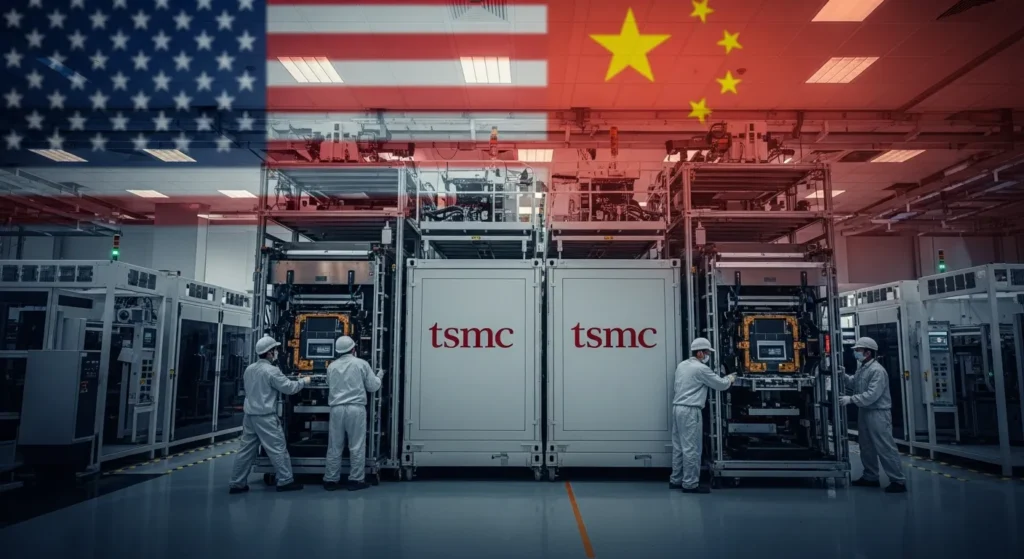

Washington has quietly given TSMC a fresh green light to keep its China chip factory running with U.S. tools, even as the tech war with Beijing keeps heating up. The move sends a mixed but powerful message to the global chip industry about how security and supply chains now move together.
What the new license actually does
The U.S. Department of Commerce has granted TSMC’s Nanjing site an annual export license covering U.S. export‑controlled equipment and related items. That means suppliers no longer need to chase individual vendor approvals for each shipment heading to the Chinese fab.
- TSMC said the approval “ensures uninterrupted fab operations and product deliveries” for customers served out of Nanjing.
- The license replaces the older “validated end‑user” waivers that expired at the end of 2025 for several Asian chipmakers.
For TSMC, the license works like a one‑year pass that keeps the tool pipeline open while still keeping Washington in control of renewals.
Why Nanjing matters, even with mature chips
TSMC’s Nanjing facility focuses on mature‑node production, including 16‑nanometre and other non‑leading‑edge technologies, not its most advanced 3 nm or 2 nm lines. In the company’s 2024 report, the site accounted for roughly 2.4% of overall revenue, a modest but still meaningful slice of its global business.
- Mature nodes still power automotive systems, IoT gadgets, industrial gear and many consumer devices.
- Keeping Nanjing stable helps large international customers avoid fresh supply shocks just as the industry tries to normalize post‑pandemic.
So even if Nanjing is not where the cutting‑edge AI chips are made, it sits inside the backbone of everyday electronics.
Part of a wider shift in U.S. export controls
The TSMC approval is not happening in isolation. South Korea’s Samsung Electronics and SK hynix have also received similar annual licenses covering U.S. chipmaking tool shipments to their Chinese fabs.
- Washington is moving from broad, open‑ended waivers to a more granular, renewable license system.
- The aim is to keep advanced tools for leading‑edge nodes out of China while allowing some mature manufacturing to continue under close watch.
In effect, the U.S. is tightening the leash without fully cutting the cord, especially for foreign companies that are key to global supply resilience.
Signals for China, Taiwan, and global chip buyers
For Beijing, the license is both a constraint and a lifeline. China’s access to state‑of‑the‑art tools remains restricted, but foreign‑owned fabs can still maintain mature production that local industries rely on.
For TSMC and Taiwan, the decision underlines how closely their China exposure is now tied to U.S. regulatory decisions. A single annual approval now shapes capacity planning, customer commitments, and long‑term China strategy for years ahead.
Chip buyers read this as a cautious win:
- Automakers and electronics firms gain more confidence that mature‑node supply from China will not suddenly go dark.
- At the same time, the risk premium around geopolitics and export rules stays firmly in the background of every sourcing decision.
What to watch in the coming months
This annual license will not be the last word. How Washington handles renewals and conditions in 2027 and beyond will tell the industry whether this is a stable mechanism or a short‑term patch.
Key questions for the next 12–18 months:
- Will the U.S. further narrow what kind of tools and upgrades can reach Chinese fabs, even for mature nodes?
- Could tighter rules push TSMC to cap or slowly reduce its China footprint while increasing investments in the U.S., Japan and Europe?
- How will China respond, both through its own chip subsidies and via pressure on foreign chipmakers operating on its soil?
Investors, policymakers and customers will all track whether this “licensed flexibility” survives the next round of political and security tensions
(Source: .taiwannews, reuters, cnbc)
