

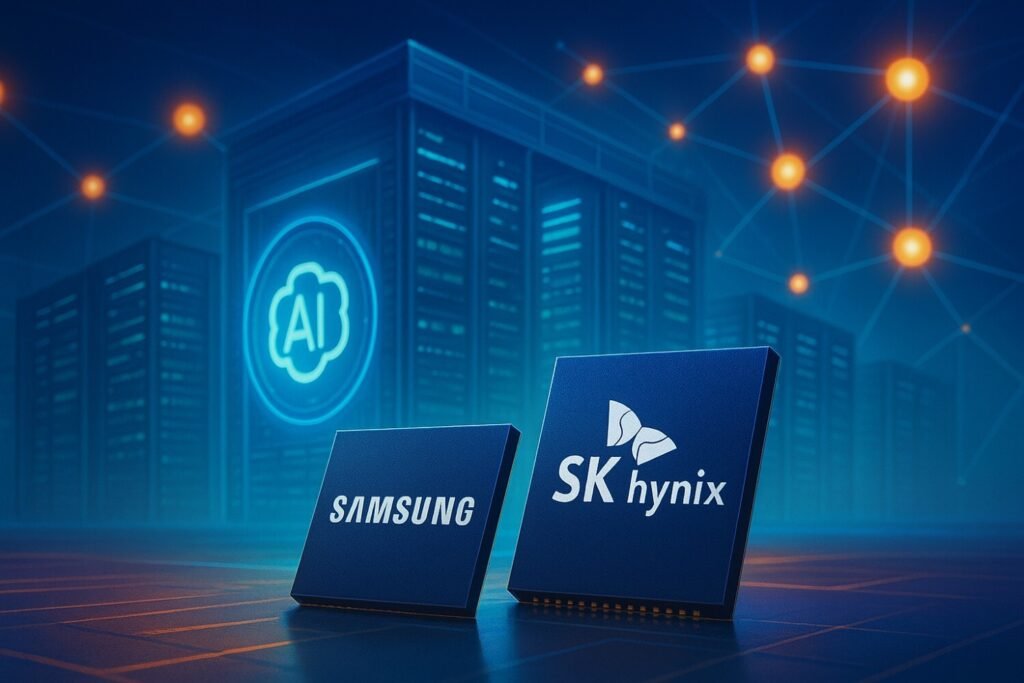

Samsung Electronics and SK Hynix, two giants of South Korea’s chip sector, have inked major agreements to provide advanced memory chips to OpenAI’s ambitious $500 billion Stargate initiative. Announced Wednesday at a landmark meeting with OpenAI CEO Sam Altman, South Korean President Lee Jae Myung, and top industry executives, the deal sets in motion a plan predicted to reshape how artificial intelligence and tech infrastructure develop for years to come.
OpenAI, backed by Microsoft, joins forces with these Korean chipmakers to build two new data centers in Seoul, tapping Korea’s vast industrial capacity and booming market for ChatGPT. The country already ranks second in subscriber counts to OpenAI’s tools, trailing only the United States. These supply agreements are pivotal, as the Stargate project plans to order some 900,000 advanced semiconductor wafers by 2029, sourced from Samsung and SK Hynix.
The output will use the latest high-bandwidth memory (HBM) tech, essential to support modern AI workloads in the world’s largest infrastructure effort. Nvidia, also part of the build-out, will invest nearly $100 billion while supplying AI accelerators for the Stargate centers. Data centers using 20+ megawatts capacity, plus offshore floating centers helped by Samsung Heavy Industries, are features that aim to make Korea a global AI hub.
South Korean president’s office emphasized the deal’s strategic value, offering domestic chipmakers an edge and growth options amid worldwide tech rivalry. Local industry leaders say, “Without chips from Samsung and SK Hynix, Stargate couldn’t be completed.” Investors note about 70% of the world’s DRAM chips already come from these two firms, with HBM production making up almost 80% of the global market. According to industry analysts, HBM’s stacked design boosts efficiency, speeds up AI workloads, and lowers energy consumption.
The partnerships reach far beyond chips. Samsung Electronics’ affiliate, Samsung SDS, signed on with OpenAI to design, build, and operate Stargate’s AI data centers, aiming to expand enterprise services. Plus, Samsung Heavy and Samsung C&T plan to help build floating offshore data centers, which could cut cooling costs and slash emissions. Experts say these new tech concepts might become standard if they work as promised.
Korean chipmakers will team up directly with OpenAI, SoftBank, Oracle, and Nvidia on the Stargate rollout. Oracle’s commitment includes building additional US centers and expanding capacity, boosting both American and Asian AI power. The multi-giant effort could mean tens of thousands of new jobs, more than 900,000 chips monthly, and Korea at the heart of global AI.
President Lee says the Stargate project presents “a growth opportunity for the domestic chip industry to shine and transform.” OpenAI CEO Altman, excited after signing the deal, called Korea’s industrial base “critical for developing AI” and looks forward to “many, many ways of working together.”
Despite enthusiasm, some investors worry about an AI bubble, as costs and expectations soar. Delays have slowed progress already due to site negotiation snags. Industry watchers keep a close eye on risks in chip pricing, power demand, and consumer adoption rates.
Alongside the supply deals, Samsung SDS deepens its work with OpenAI to roll out enterprise AI services in Korea and abroad. Shipbuilder Samsung Heavy and Samsung C&T try to tackle green tech with floating center designs. SK Telecom works with OpenAI on a local dedicated AI data center in southwest Korea. Google’s rumored talks with Korean partners could lead to even more major tech tie-ups.
With South Korea now a clear leader in the global AI chip race, the Stargate project could spark more cooperation between East and West. Local market cycles and advances in DRAM efficiency may influence project worth—currently estimated at $70 billion for the chips alone.
In summary, these deals put South Korea’s chip industry front and center as OpenAI aims to scale the largest AI infrastructure project ever built. For Samsung, SK Hynix, and their partners, the next few years could decide who leads the future of artificial intelligence—at home and everywhere else.
(Source: openai, seekingalpha, kedglobal, bloomberg, ndtvprofit)
