

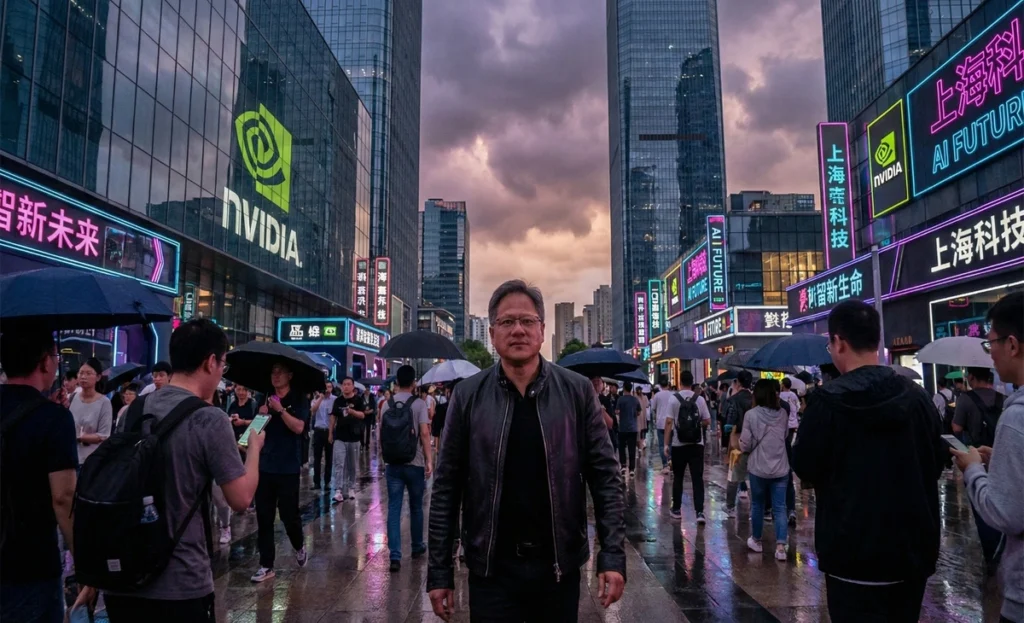

Nvidia boss Jensen Huang is now in Shanghai while Beijing slowly decides how far U.S. AI chips can go into China. The trip looks normal on paper but comes at a moment when every move in chips feels like a stress test for global tech rules.
Why this Shanghai trip matters now
Huang’s stop in Shanghai kicks off Nvidia’s regular Lunar New Year–season events with its China team, something the company has done for years. This time, the visit sits inside a fight over who controls the next wave of AI power, from data centers to national security.
China used to deliver at least a fifth of Nvidia’s data‑center revenue before export rules hit its top AI accelerators. Now every visit by Nvidia’s CEO doubles as both staff handshake tour and quiet negotiation signal to regulators and customers.
Beijing’s pause on H200 imports
Washington has already cleared Nvidia to sell its H200 accelerator to Chinese buyers under tailored export rules. But people close to the matter say Chinese customs officers have been told that H200 units cannot enter for now, leaving Nvidia in a holding pattern.
No one outside top officials knows yet if this is a formal long‑term ban or just a temporary stop while Beijing rewrites its own tech guardrails. For Chinese AI labs and cloud players that want H200 performance today, that means projects and budgets sitting in limbo.
Meanwhile, the memory of earlier H20 restrictions still hangs over the market; that U.S. move forced Nvidia to write off billions of dollars and rethink how it serves China. Those scars explain why every new chip approval or hold gets read as a strategic signal, not just a trade rule.
Local chip rivals smell an opening
While H200 waits at the border, Chinese chipmakers see room to grow with home‑grown accelerators tailored to domestic AI demand. Firms backed by big internet groups and state funding are racing to build GPUs and AI systems that can live entirely inside China’s supply‑chain walls.
This pressure means Nvidia is no longer just the default high‑end choice in China’s AI market. Price, availability and long‑term political risk now weigh almost as much as raw performance when Chinese buyers pick their next GPU rack.
Still, interest in Nvidia’s hardware has not gone away; major Chinese companies continue to signal demand if H200 shipments get a green light. For Nvidia, that demand keeps China worth the headache, even as export controls and local rivals pull at its margins.
Huang’s wider China agenda
People familiar with the schedule say Huang will attend an Nvidia party in Shanghai, then travel on to Beijing and Shenzhen before heading to Taiwan. Those stops mirror Nvidia’s spread of partners, government contacts and hyperscale customers across the region.
Last year, Huang made at least three trips to China and even met the commerce minister, underscoring how central the market remains. This year’s journey continues that pattern but with more focus on reopening AI chip sales at scale after months of policy whiplash.
The Shanghai leg also carries optics: walking through Nvidia’s local offices, visiting public spots and being seen with staff helps show that the company is still invested on the ground. In a tech climate where talk of “decoupling” is constant, such images matter to both Chinese partners and global investors.
Signals for the next three months
Over the coming quarter, three threads will shape how this visit is judged in hindsight: Beijing’s final word on H200, the speed of local GPU roll‑outs and any hint of warmer regulatory tone. A narrow approval with strict caps would keep Nvidia in the game but push it to keep diversifying beyond China.
A prolonged block could accelerate Chinese funding into domestic accelerators and alternative AI systems not tied to Nvidia’s CUDA ecosystem. That shift would ripple through cloud architecture, software tooling and AI training choices across the region.
For now, Huang’s presence in Shanghai sends a simple message: Nvidia still wants to be part of China’s AI build‑out, even under tougher rules. Whether regulators open the door or keep it half closed will decide how much of that ambition turns into shipped silicon.
Short key points for readers
- Nvidia CEO Jensen Huang is in Shanghai for annual staff events amid fresh regulatory pressure.
- China customs officials have reportedly halted H200 chip imports despite U.S. approval.
- Local Chinese GPU makers are racing to fill any gap if Nvidia’s hardware stays restricted.
- Huang will also visit Beijing, Shenzhen and Taiwan on this trip.
- Beijing’s H200 decision will shape China’s AI hardware mix for the next phase of deployment.
(Source: reuters, bitget)
