

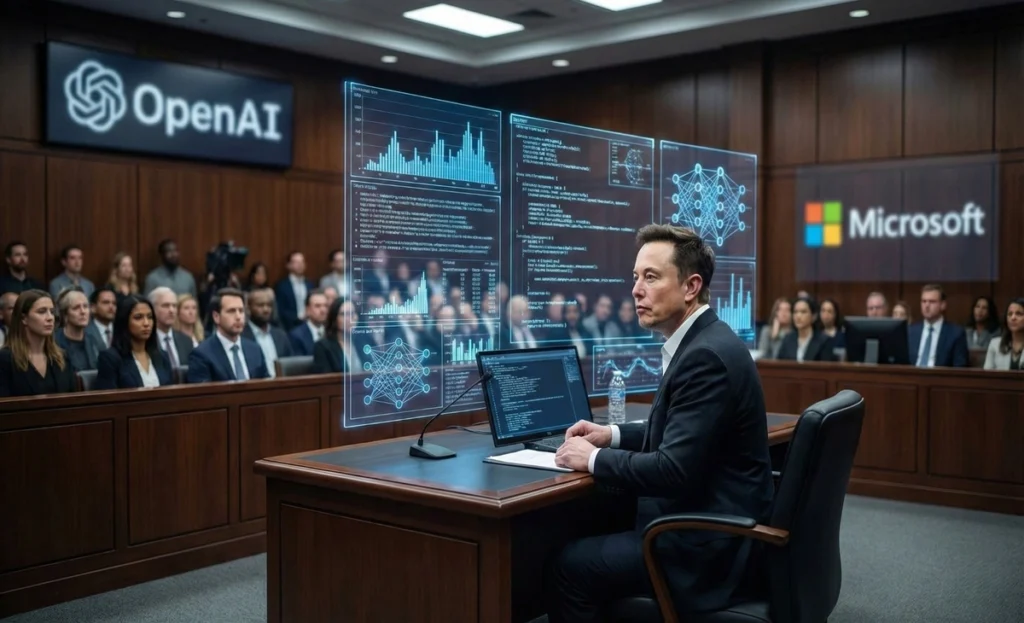

Elon Musk now sits in the middle of one of biggest money fights in tech, with a demand that may reshape how the AI boom share its rewards. He says OpenAI and Microsoft made huge “wrongful gains” from his early push to build safe artificial intelligence and now must pay up.
How Musk says OpenAI broke its promise
Musk helped start OpenAI in 2015 as small research group with nonprofit mission to build AI that help all people. He says he put about $38 million into the project, gave advice on tech and business, hired key people and used his name to make big talent and investors pay attention.
Today OpenAI sit on a sky‑high valuation near $500 billion after its generative AI tools, like ChatGPT, changed how people think about software. In the new court filing, Musk’s expert, financial economist C. Paul Wazzan, tries to turn that history into a big bill.
The expert says Musk’s early cash and non‑cash help are worth tens of billions now, because they gave OpenAI lift‑off in its first years. The filing calls this value “wrongful gains” that OpenAI and Microsoft should give back, in the same way an early startup investor can see returns far beyond the first cheque.
Why the $79–134 billion number is so huge
The new filing lays out a wide range: Musk wants damages between $79 billion and $134 billion from OpenAI and Microsoft together. Wazzan puts OpenAI’s share of the gains at roughly $65.5–$109.4 billion and Microsoft’s at about $13.3–$25.1 billion.
In simple words, the expert is saying: if OpenAI is now worth around half a trillion dollars, Musk’s early push deserves a big slice of that pie. Musk argues that, without him, the lab might never have reached the scale, capital and trust needed to turn into today’s AI giant.
Lawyers for OpenAI and Microsoft fire back that this math is extreme. In a response, they say Musk is asking for as much as 2,900 times the money he first put in, calling the method “made up”, “unverifiable” and “unprecedented”.
OpenAI and Microsoft hit back hard
OpenAI’s public line is blunt: the company calls Musk’s demand “unserious” and part of what it describes as a longer “harassment campaign”. The firm says the lawsuit is “baseless” and frames it as a move to slow a rival now that Musk runs his own AI startup, xAI, with chatbot Grok.
Microsoft also disputes the idea that it “aided and abetted” any wrongdoing by OpenAI. The software giant has poured billions into OpenAI and holds about 27% of the for‑profit arm after a restructuring that kept the nonprofit side in formal control.
Both companies are asking the judge to stop Musk’s expert from showing his damages model to the jury. They argue that shifting tens of billions from a nonprofit‑born AI lab to a donor‑turned‑competitor would mislead the jury and clash with normal charity and corporate rules.
What the court battle is really about
At the core sit one question: did OpenAI abandon its original nonprofit promise when it created a for‑profit structure and partnered tightly with Microsoft. Musk says yes, claiming he was tricked when the lab moved away from its mission of building AI “for the benefit of humanity” and closer to a commercial engine.
A judge in Oakland, California, has already said the case will go to a jury trial, now expected to start around April. Musk’s filing says he may also ask for punitive damages and even an injunction, though it doesn’t spell out exactly what limits on OpenAI or Microsoft he would seek.
This trial will likely drag internal documents, board debates and deal terms into the open. For the fast‑moving AI world, that could expose how much power big backers like Microsoft really hold over cutting‑edge research labs that still talk about broad social missions.
Why this matters for the AI gold rush
The lawsuit arrives just as governments, investors and users argue over who should own future AI profits and how much of the technology should stay open. If Musk wins even a chunk of his $134 billion claim, other early donors, founders and partners in AI projects may try similar moves.
It could also push future AI labs to write much clearer rules around nonprofit pledges, for‑profit spin‑offs and mega‑partnerships with cloud giants. For Microsoft and OpenAI, the case adds legal risk and public‑trust questions on top of earlier fights with regulators and rivals.
For everyday users and developers, the case highlights a simple tension: AI tools look free or cheap on the surface, but the control, money and data behind them sit with a small set of firms. How this trial ends may shape how much of that value they must share with early backers—and, indirectly, with the wider ecosystem building on top of their models.
(Source: reuters, bloomberg)
