

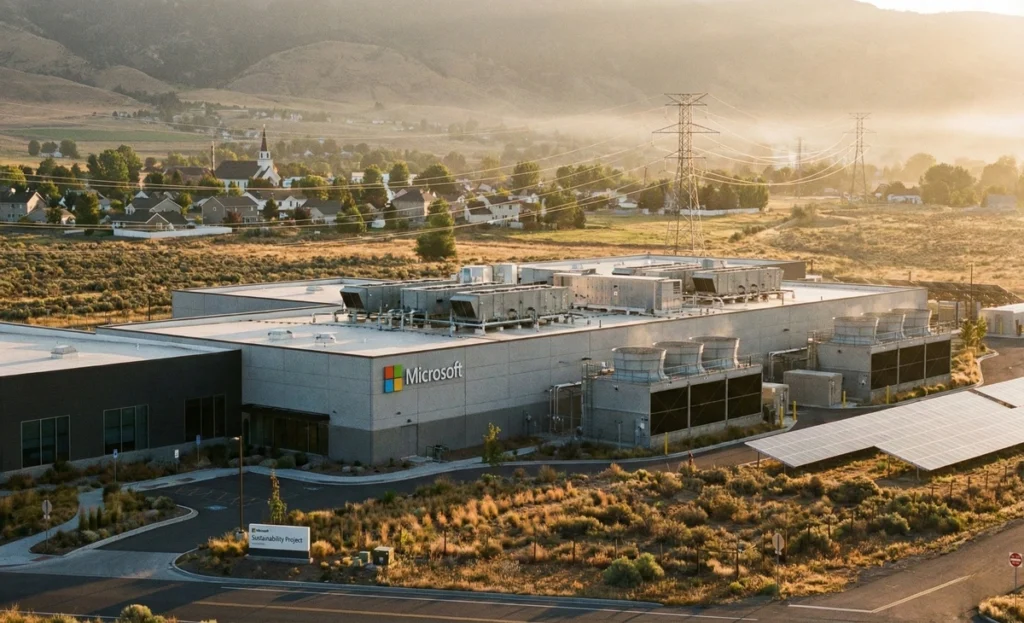

Microsoft is changing how it builds and runs big AI data centers in the United States. The company now says these sites must grow without pushing up local power bills or draining community water.
What Microsoft announced
On 13 January 2026, Microsoft launched a community-first AI infrastructure initiative for its U.S. data centers. The plan shapes itself as a long-term promise to local towns that host the power-hungry facilities behind cloud and AI services.
Key points from the announcement:
- New U.S. AI data center build-out will follow a “Community-First AI Infrastructure” framework.
- Microsoft says it will prevent its data centers from raising local electricity prices.
- The company commits to cut water use and replenish more water than it consumes in stressed regions.
Power costs: “We’ll pay our way”
Public worry over rising bills near big tech facilities has grown, especially as AI drives heavy computing loads. Microsoft now says communities should not see higher electricity prices just because an AI data center arrives in the area.
Under the new approach:
- Microsoft pledges to cover the full power costs tied directly to its data center operations, instead of shifting them onto households.
- The company will work with utilities on grid planning so new AI demand does not trigger unexpected rate hikes.
- Local tax breaks tied to data center energy use face more scrutiny, with a stated focus on “pay our way” rather than subsidies.
In practice, this means Microsoft will negotiate with power providers to handle the extra load from AI servers and cooling equipment while trying to shield local customers from pass‑through costs.
Water use: from heavy draw to replenishment
Modern data centers can consume millions of gallons of water a day for cooling, often in regions already under stress. Microsoft has faced questions over water draw at several sites, and this new initiative builds on its earlier pledge to replenish more water than it consumes by 2030.
The current plan leans on three big changes:
- Shift to next‑generation designs that use zero water for IT cooling by moving to chip‑level and air‑based systems.
- Use more reclaimed and recycled water in existing facilities where cooling water is still needed.
- Fund watershed and local projects in stressed regions so the company returns more water to the environment than its sites withdraw.
Microsoft says its latest data center design, rolled out in 2024, can avoid over 125 million liters of cooling water per site per year by eliminating evaporative cooling. The company also reports a global Water Usage Effectiveness (WUE) improvement, targeting near‑zero levels for new zero‑water‑cooling sites.
Community-first: five‑point framework
The broader Community-First AI Infrastructure plan is structured around five commitments to host regions. While Microsoft highlights many program details, three stand out for local stakeholders.
- Good neighbor economics: Promise to prevent AI data centers from raising local power prices and to avoid relying on local tax breaks that shift costs to residents.
- Efficient infrastructure: Use AI and new hardware designs to squeeze more compute out of each watt, and move toward zero‑water cooling where possible.
- Skills and social investment: Support AI education, training hubs, and nonprofit funding in the same communities that host data centers.
Microsoft plans to work with local libraries and community partners to set up AI learning hubs in major data center regions. The idea is that local workers and students gain early access to tools and training built on the very infrastructure in their backyard.
Why this move matters now
AI workloads are rapidly increasing, leading to a corresponding rise in the demand for electricity and water. Several U.S. regions have seen public pushback over land, noise, traffic, power, and water draws from hyperscale sites, especially in suburbs and rural zones.
Microsoft’s initiative lands at a moment when:
- Residential electricity prices have risen in data‑center‑dense states, spotlighting who pays for AI growth.
- Local governments are rethinking tax incentives for large tech facilities.
- Climate targets are forcing cloud providers to rethink both carbon and water footprints.
By presenting a public framework, Microsoft is trying to set a benchmark for what a “responsible” AI infrastructure build‑out looks like in the U.S.
What to watch in the coming months?
The next three to six months will test how this framework translates from blog posts and press releases into local deals. Communities, regulators, and utilities will watch whether new data center projects adopt zero‑water designs, transparent power agreements, and real funding for local skills programs.
For technology and infrastructure observers, key signals include:
- Public rate filings from utilities serving new Microsoft AI data sites.
- Environmental impact disclosures that quantify water draw and replenishment at site level.
- Local feedback from towns weighing new data center proposals under the community‑first banner.
