

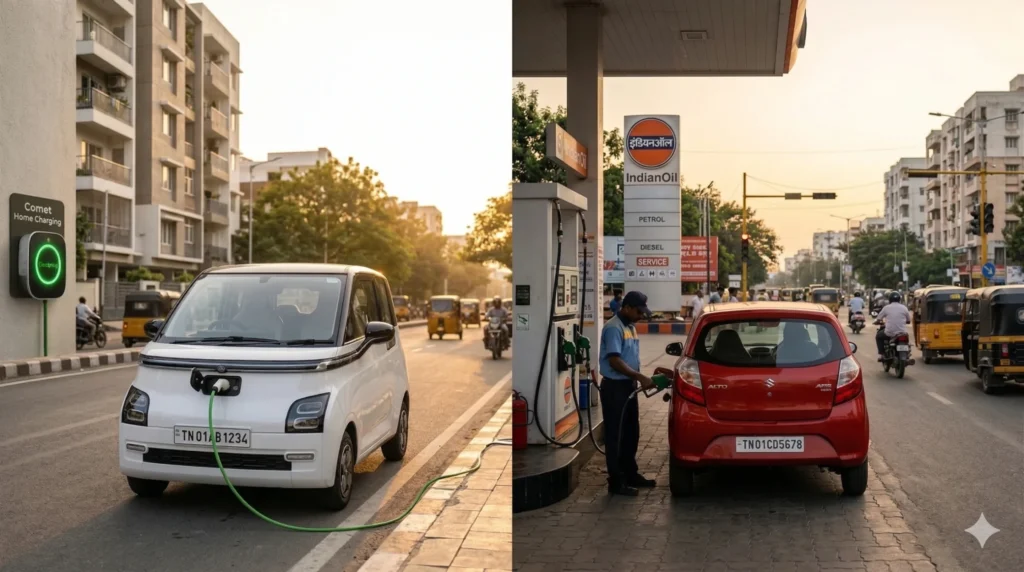

The 2026 MG Comet EV (starting at ₹7.50 lakh ex-showroom) costs approximately ₹3 lakh more than the mid-spec Maruti Alto K10 VXi (₹4.50 lakh) — but the 100% Tamil Nadu road tax exemption and ₹1.00/km running cost mean the on-road price gap is far smaller than the showroom quote suggests.
For an urban driver commuting 40 km a day in city traffic, the MG Comet EV fully pays off its premium over the Alto K10 in approximately 3.5 years — after which every kilometre driven is pure saving.
This breakdown uses verified 2026 data: TANGEDCO’s realistic 501+ unit domestic tariff (₹9.10/kWh), confirmed Tamil Nadu EV road tax exemption until December 31, 2027, and a conservative real-world city range of 180 km (not the ARAI-certified 230 km) — because engineering analysis uses real numbers.
The Upfront Cost: Why Tamil Nadu Buyers Pay Less Than the Showroom Quote Suggests
Budget petrol cars get hit hard by RTO taxes. A Maruti Alto K10 in the Rs 4–5 lakh bracket attracts 12% life tax on its ex-showroom price in Tamil Nadu — an immediate Rs 54,000 addition before you leave the showroom. EVs pay zero. That Rs 54,000 asymmetry is the first number your comparison must account for.
| Cost Component | Maruti Alto K10 VXi (1.0L Petrol) | MG Comet EV Executive |
|---|---|---|
| Ex-Showroom Price | Rs 4.50 lakh | Rs 7.50 lakh |
| Road Tax (Tamil Nadu) | Rs 54,000 (12% Life Tax) | Rs 0 — ZERO (100% EV Exemption) |
| Registration / Smart Card | Rs 3,200 (approx) | Rs 2,500 (approx) |
| Insurance (1st Year OD+TP) | Rs 22,000 – Rs 25,000 | Rs 35,000 – Rs 42,000 |
| Home Charging Setup | Not applicable | Standard 15A socket — no extra cost (no wall-box needed) |
| Estimated On-Road Total (TN) | Rs 5.29 – Rs 5.32 lakh | Rs 7.87 – Rs 7.94 lakh |
Data: CarWale + Autocar India April 2026 price lists. TN road tax for cars priced up to Rs 5L: 12% of ex-showroom value; Rs 5L–Rs 10L: 13% of ex-showroom value. EV road tax exemption: Tamil Nadu EV Policy 2023, confirmed via G.O. Ms. No. 674 (Home Department, December 28, 2025) until December 31, 2027. MG Comet EV charges via standard 15A home socket — no dedicated wall-box charger required, unlike most larger EVs.
Net effective price gap after road tax (Tamil Nadu): approximately Rs 2.58 lakh — not the Rs 3.00 lakh headline ex-showroom gap. No home charger installation cost is added because the MG Comet charges from a standard 15A domestic socket. This is a genuine structural advantage over larger EVs.
Real-World City Running Costs: Why the Comet EV’s Tiny Battery Is Deceptively Good in Traffic
There is an engineering reason why small EVs excel in dense city traffic that most comparisons miss. Regenerative braking converts energy that petrol engines waste as heat into electricity. Every time the Comet decelerates in stop-and-go traffic, it is partly recharging its battery. Meanwhile, the Alto K10’s 1.0L engine is idling and burning fuel at 0 km/L every time it is stationary at a signal. In pure city conditions, the gap between EV and petrol efficiency widens compared to highway driving — the opposite of what many buyers expect.
The MG Comet EV’s 17.3kWh LFP battery delivers roughly 180 km in real-world city conditions with the AC running — not the 230 km ARAI figure measured at 25°C with no AC in a lab. The Alto K10 delivers roughly 18 km/L in heavy stop-and-go city traffic (ARAI claims 24.39 km/L, but heavy traffic cuts that significantly). Use these real numbers in your financial model, not the brochure figures.
Petrol vs. EV Running Cost — City Driving, 40 km/Day
| Expense Category | Alto K10 VXi (Rs 100/L) | MG Comet EV (TANGEDCO Rs 7/kWh) |
|---|---|---|
| Real-world mileage / range | 18 km/L (city, heavy traffic) | 180 km per full charge (city, AC running) |
| Cost per kilometre | Rs 5.56/km | Rs 0.67/km |
| Annual fuel / electricity (14,600 km) | Rs 81,176 | Rs 9,782 |
| Annual maintenance | Rs 9,000 (service + consumables) | Rs 4,500 (minimal — no oil, plugs, exhaust) |
| Annual insurance (own damage) | Rs 12,000 – Rs 14,000 | Rs 14,000 – Rs 16,000 (higher IDV for EV) |
| Net Annual Saving (EV over Petrol) | — | Rs 73,894/year |
Calculations: EV full charge = 17.3 kWh x Rs 7/kWh = Rs 121. Running cost = Rs 121 / 180 km = Rs 0.67/km. Petrol = Rs 100 / 18 km/L = Rs 5.56/km. Annual km = 40 km/day x 365 = 14,600 km. Net annual saving = fuel saving (Rs 71,329) + maintenance saving (Rs 4,500) – insurance extra (Rs 2,000) = Rs 73,829. Verify petrol price at Chennai pump on publish date.
Why 14,600 km/Year and Not 18,250 km/Year?
This teardown uses 40 km/day (14,600 km/year) — the daily commute assumption stated in the brief — rather than the 50 km/day used in the Nexon and Punch teardowns. The Comet EV is explicitly positioned as a city car for shorter urban commutes. If your actual daily commute is longer, re-run the model in the calculator — your payback period will be shorter.
Is the MG Comet EV the Right Financial Choice for You?
The 3.5-year payback assumes a 40 km/day city commute. If this is strictly a 15 km/day school-run car, the math changes completely — your annual saving drops proportionally and the payback stretches. If you drive 60+ km/day, the Comet pays off even faster.
Three inputs determine your exact break-even: your daily km, your TANGEDCO slab, and your local petrol price. Stop guessing.
RUN YOUR EXACT COMMUTE IN THE EV CALCULATOR →Battery Life in a City Beater: The LFP Advantage and Why It Matters
The MG Comet EV’s battery chemistry deserves a dedicated section because it directly determines the vehicle’s long-term value proposition in Indian city conditions.
LFP Chemistry — Why It Suits the Indian City Context
The MG Comet uses a 17.3kWh Prismatic LFP (Lithium Iron Phosphate) battery. LFP chemistry is inherently more thermally stable than NMC (Nickel Manganese Cobalt) batteries used in many larger EVs. This matters significantly in Chennai’s 35–40°C summer heat, which accelerates degradation in NMC cells but has less impact on LFP chemistry. LFP batteries also tolerate frequent charging to 100% better than NMC cells, which is important for a city car that may be charged every night.
LFP chemistry advantages for a city commuter car in India:
- Slower capacity degradation in high-ambient-temperature conditions (Chennai summer heat affects LFP less than NMC)
- Safe to charge to 100% regularly — no need to limit to 80% as recommended for NMC packs
- More charge cycles before degradation threshold — LFP cells are rated for 3,000+ cycles vs 1,000–2,000 for NMC
- Lower fire risk — LFP chemistry does not undergo thermal runaway at the same temperature thresholds as NMC
Battery Warranty — Updated for 2026
| Lifetime Battery Warranty — MG Comet EV (First Owner, Updated March 2025) |
|---|
| Critical Update: MG upgraded the Comet EV to a Lifetime Battery Warranty (unlimited km) for the first private owner in March 2025. The outline’s reference to 8-year/1,20,000 km is now outdated for first owners. |
| Lifetime Battery Warranty (first private owner): unlimited kilometres, for the duration of first ownership. MG will repair or replace the battery if it degrades below the warranted State of Health threshold. |
| If the vehicle is sold: the second owner’s coverage reverts to 8 years / 1,20,000 km from the original date of registration — not from the date of resale. |
| What the warranty does NOT cover: physical damage, flooding, damage from uncertified 3rd-party chargers, commercial use, or unauthorised modifications. |
| Practical implication: for a city commuter doing 14,600 km/year, the battery is fully protected for the entire statistical first-ownership window at zero additional cost. |
Degradation Data for LFP in Indian City Conditions
| Usage Pattern | Annual Capacity Loss | Remaining at Year 8 |
|---|---|---|
| Ideal City Use (Home 15A socket, regular 100% charge) | 1.2% – 1.5% / year | ≈ 90% – 91% remaining |
| Heavy City Use (Frequent deep discharge, high ambient heat) | 1.5% – 1.8% / year | ≈ 86% – 88% remaining |
| Frequent DC Fast Charging | Not applicable — Comet EV has no DC port | — |
The MG Comet EV does not support DC fast charging — it charges only via AC (up to 7.4kW). This eliminates the fastest source of battery degradation for most city owners. At Rs 121 per full charge (Rs 7/kWh x 17.3 kWh), home charging overnight on a standard 15A socket is the only required infrastructure.
5-Year Total Cost of Ownership: Comet EV vs. Alto K10 (Tamil Nadu, 40 km/Day)
40 km/day (14,600 km/year). TANGEDCO Rs 7/kWh. No home charger cost added — Comet uses standard 15A socket.
| Cost Element | Maruti Alto K10 VXi | MG Comet EV Executive | Engineering Rationale |
|---|---|---|---|
| Ex-Showroom Price | ₹4,49,900 | ₹7,49,800 | Prices as of April 2026. |
| Road Tax (Tamil Nadu) | ₹53,988 (12%) | ₹0 (100% Exempted) | Tax is 12% for petrol <₹5L; EVs exempt till 2027. |
| Registration / Fees | ₹3,200 | ₹2,500 | Standard RTO registration & smart card fees. |
| Year 1 Insurance | ₹23,000 | ₹32,000 | Current comprehensive rates for hatchbacks vs EVs. |
| Initial On-Road Total | ₹5,30,088 | ₹7,84,300 | Total upfront cost at dealership. |
| 5-Year Fuel / Energy | ₹4,05,880 | ₹48,910 | Petrol at ₹100.90/L vs Home Electricity. |
| 5-Year Maintenance | ₹18,500 | ₹13,000 | Alto is ~₹3.7k/year; Comet is ~₹2.6k/year. |
| 5-Year Insurance (Yrs 2-5) | ₹60,000 | ₹70,000 | Estimated premium for years 2 to 5. |
| 5-Year Total Cost (TCO) | ₹10,14,468 | ₹9,16,210 | The total cost to own and run the car for 5 years. |
| Total 5-Year Savings | — | ₹98,258 | Net savings by choosing the EV. |
Figures: petrol Rs 100/L, TANGEDCO Rs 7/kWh, 14,600 km/year (40 km/day), real-world city mileage 18 km/L petrol / 180 km per charge EV. Insurance Years 2-5: Rs 12,000/year petrol avg, Rs 14,000/year EV avg. Road tax reflects TN 100% EV exemption (G.O. Ms. No. 674). Verify all prices with MG and Maruti dealers before purchase. MG Comet EV Executive price may have changed — price hike announced in early 2026.
