

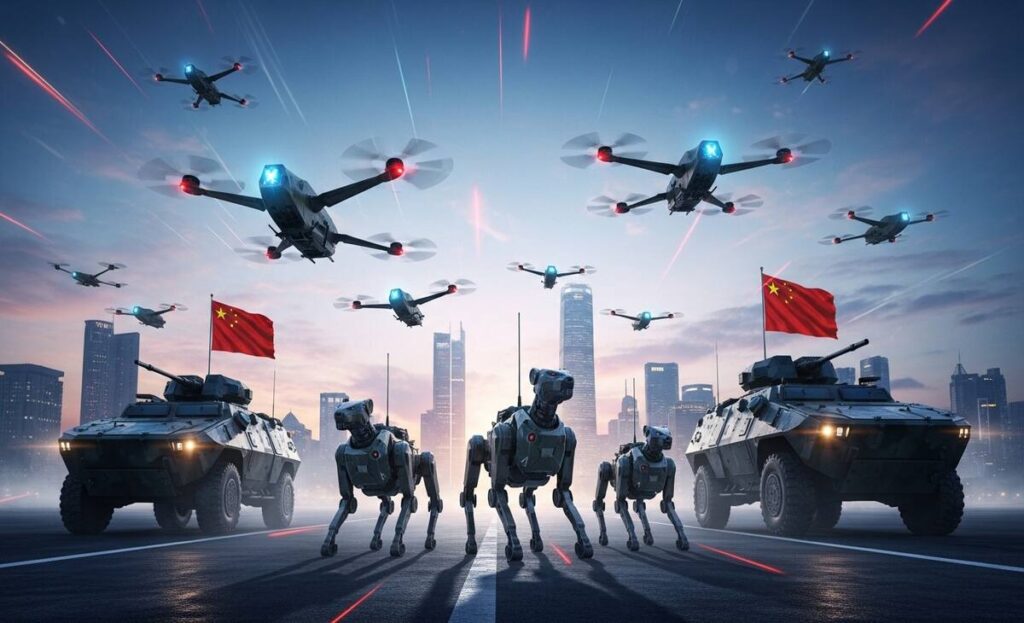

In spring, Unitree robot dogs, looking like animals but with hard legs and steel skin, climbed a flight of stairs in Hangzhou for a government demo. Troops around snap videos in awe, watching the dogs’ heads look left, right, up, and down—each step careful, never tripping. Eyes on them, Chinese state TV anchor says, “This is only the start.”
For China, 2025 is a tech war year. Scientists, generals, and computer makers say the key? DeepSeek, an artificial intelligence model built in China, now running in robots and vehicles. China’s army, called the PLA, is testing DeepSeek in robot dogs and drone swarms too.
DeepSeek Steps into the Battlefield
Norinco, the country’s big weapons company, revealed a military vehicle, the Norinco P60, in February. It speeds along at fifty kilometers an hour, no person inside. The P60’s “brain,” officials brag, is DeepSeek. They hope it will catch up to what the US Army can do. Tenders and research papers show more and more Chinese defense groups are choosing DeepSeek over rivals like Alibaba’s Qwen—a shift noticed all year in government notes and tech forums.
Tech Race: America vs. China, Chips vs. Models
Since 2022, the US government has tried blocking China from advanced chips, claiming “national security.” Top among those chips are Nvidia’s. Yet, patents from 2025 show the PLA still mentions Nvidia inside its AI research. There’s a twist: China is shifting fast to home-grown chips, like Huawei’s Ascend. This campaign for “algorithmic sovereignty” means less Western tech, more local hardware, keeping everything under Chinese control.
Security expert Sunny Cheung says, “We see more PLA contracts in 2025 mention Huawei than ever before.” Huawei doesn’t talk about this, but patent filings and inside sources confirm the trend.
Robot Dogs, Drone Swarms, and AI War Games
This year, China’s army put out a call for “packs of robot dogs” that could sweep areas for dangers or bombs. The request sounded like science fiction—nobody finds out who gets the deal. Still, real footage shows PLA squads using armed Unitree dogs in field drills. These four-legged bots look for threats and clear routes before soldiers come.
Autonomous drones are also changing battle plans. New research from Beihang University shows how DeepSeek makes drone swarms smarter, letting them fly together, spot targets, and adjust their path without human hands guiding every move. The term “low, slow, small” gets repeated—a code for tracking tricky flying objects, especially enemy drones or small aircraft.
At Xi’an Technological University, papers claim DeepSeek can check 10,000 battle scenarios in 48 seconds, work that takes military planners whole days to do by hand. That’s speed that turns the tide.
Command centers are changing, too. With AI, planners look at satellite pictures, maps, and reports on screens so big, they cover the wall. A Chinese defense firm says their DeepSeek-powered software can flag enemy spots, check terrain, and send orders to radar or air teams before a human staff meets in a war room.
Caution: Are the Robots in Control?
China promises human officers always press the “fire” button. Still, with algorithms and hardware growing smarter, that line blurs. Twenty-four patents in two years show China is trying to weave AI into war—often mimicking what tech the Pentagon is developing. The US also wants to launch thousands of AI drones by the end of 2025, with the goal to overwhelm Chinese numbers with better, faster bots.
A Washington spokesperson simply says, “DeepSeek has chosen, and will keep, helping China’s armed forces and intelligence.” Their plans: US and friends will build their own strong AI, ban sales to “bad guys,” and try to stay a step ahead.
Global Stakes: The Next Era in Tech-Fueled Conflict
China’s 1.4 billion citizens and surveillance power make a testing ground. More than 700 million cameras feed fresh data to train these AI models daily. As DeepSeek powers everything from robot dogs to command dashboards, security thinkers worry: Is the future safe when robots listen only to code, not to humans? Will there be accidents nobody sees coming?
For now, pictures of marching robot dogs and humming drone flocks are still rare. But the race is running fast. Every new patent, every demo, every day—people and policymakers are pushing the boundaries of how machines and minds make war.
(Source: reuters, news, newsx, startupnews)
