

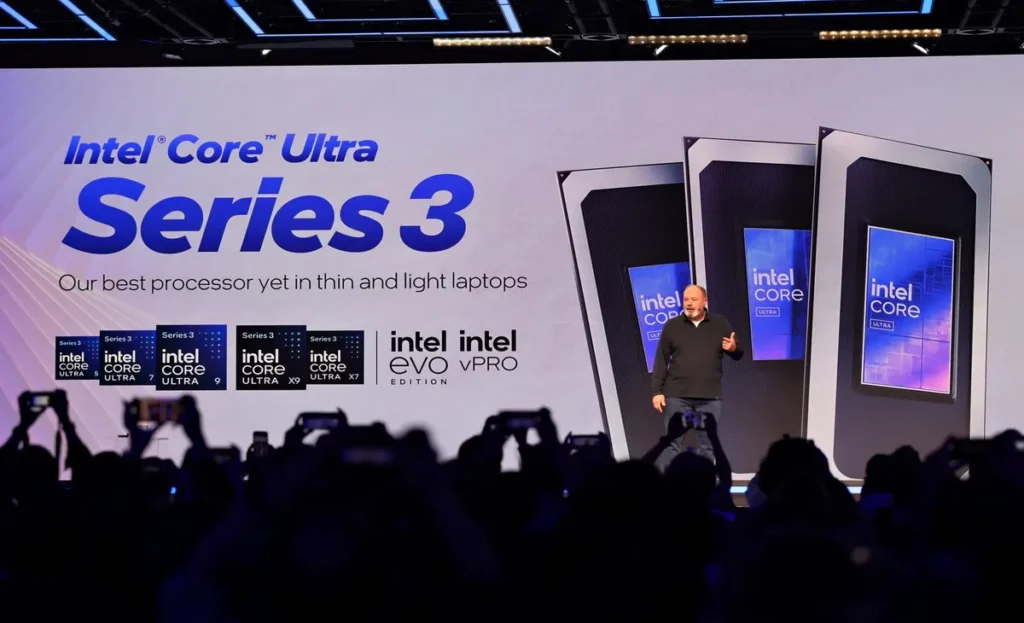

Intel is turning CES 2026 into a launchpad for its Core Ultra Series 3 laptop chips, the first full PC platform manufactured on the company’s new Intel 18A process. These “Panther Lake” processors aim at AI PCs, gaming rigs and thin‑and‑light notebooks all at once.
The new line sits at the center of Intel’s plan to win back share from AMD and other rivals by showing it can ship advanced nodes at scale again. The Hindu notes that Intel executives have been under pressure to prove 18A yields are in shape after earlier struggles.
What’s inside Core Ultra Series 3
Intel’s Series 3 family introduces new X9 and X7 mobile chips with a bigger integrated Arc GPU, fresh performance and efficiency cores, and a boosted NPU for AI.
Key points in simple terms:
- Up to 16 CPU cores and 12 Xe graphics cores in the top X9 SKUs for heavy multitasking and modern games.
- Integrated NPU capable of around 50 TOPS for on‑device AI workloads such as generative tools, assistants and live video effects.
- Intel claims about 60% better multithread performance and roughly 77% faster gaming versus the Series 2 generation at similar power.
- Laptop battery life targets up to about 27 hours of streaming on some designs, according to Intel’s own measurements.
The same underlying architecture also appears in a simpler Intel Core (non‑Ultra) lineup aimed at mainstream notebooks and lower price points. These chips reuse the same building blocks but scale down graphics and AI muscle to match cheaper designs.
Why Intel 18A process matters
The 18A node brings RibbonFET gate‑all‑around transistors and backside PowerVia delivery, a big internal shift from older Intel processes. Intel’s goal is more performance per watt so laptops can stay thin while still running AI models and games longer on battery.
At CES, Intel pointed out that Series 3 systems are lined up across more than 200 laptop designs from partners such as Samsung and others. For investors, that scale plus working 18A silicon is a signal that Intel’s manufacturing roadmap is finally moving from slide decks into real products.
From PC desks to robots and smart cities
A big twist with Series 3 is that the same platform is also certified for embedded and industrial use at the edge. Intel is positioning these chips for robots, smart city systems, healthcare devices and automation gear that need 24×7 uptime and extended temperature support.
On AI workloads, Intel highlights some internal comparisons:
- Up to 1.9x higher large language model performance in some tests versus certain competing edge platforms.
- Up to 2.3x better performance per watt per dollar on end‑to‑end video analytics workloads.
- Up to 4.5x higher throughput on vision‑language‑action models, which matter for robotics and complex video understanding.
These gains come from packing CPU, GPU and NPU onto a single SoC, which Intel argues can cut total cost of ownership compared with separate CPU plus GPU setups at the edge.
Availability and what comes next
Consumer laptops with Intel Core Ultra Series 3 start taking pre‑orders from January 6, 2026, with global retail availability slated around January 27, 2026. Additional notebook designs are expected to roll out through the first half of the year.
Edge and embedded systems built on the same silicon are planned to arrive from the second quarter of 2026. Intel’s Jim Johnson also talked about a handheld gaming platform based on Panther Lake due later this year, as Intel tries to ride the growing handheld PC trend.
(Source: intel)
