

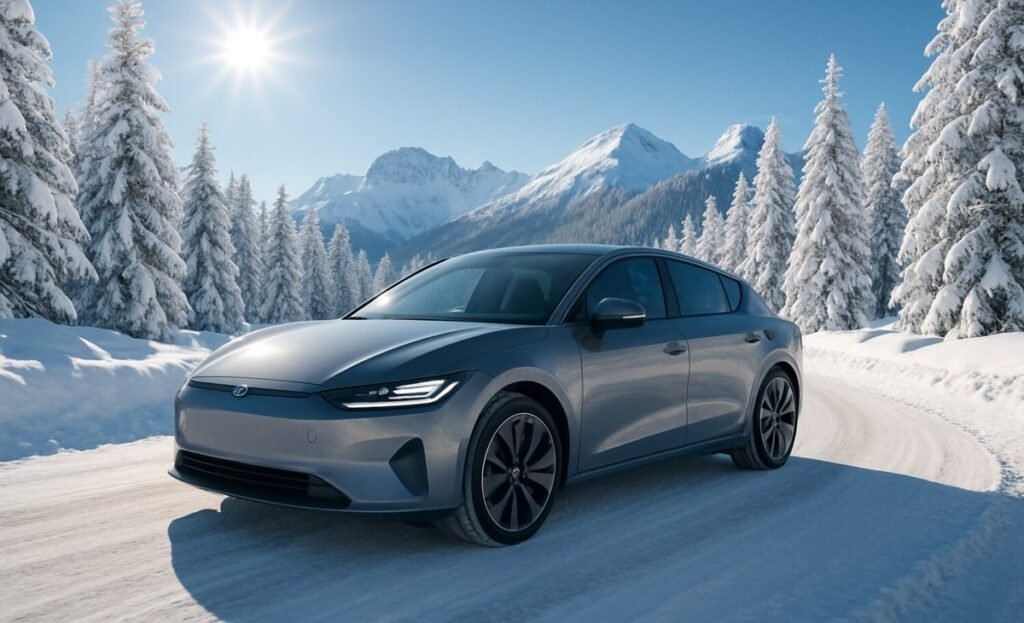

We utilise AI tools to create images and videos in this article. If you notice any errors or mistakes, please let me know so we can correct them. This content is authored by humans.
Planning a winter trip to the hills with your family?
Let me tell you something that happened to my friend Rajesh from Delhi last year.
He bought his first electric car without thinking about winter performance.
When he drove to Manali in December, the range of his vehicle dropped by almost 40%.
What was supposed to be a smooth family vacation turned into range anxiety and multiple unplanned charging stops.
Don’t let this happen to your family.
Winter can be tough on electric cars, but some models handle it like champions.
Cold weather can affect EV batteries, but the right car with the proper features can still deliver excellent performance even when temperatures drop.
How Cold Weather Affects Your Electric Car
The Science Behind Winter Range Loss
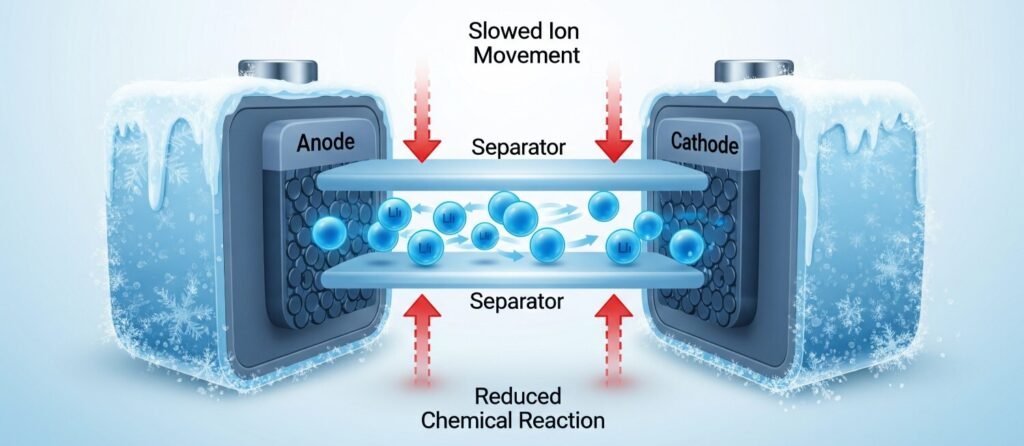
Your EV’s battery works through chemical reactions.
When it gets cold, these reactions slow down – just like how your phone battery drains faster in winter.
But here’s what most people don’t know:
- Battery chemistry slows down – The lithium ions move more slowly in cold temperatures
- Extra energy goes to heating – Unlike petrol cars that use waste engine heat, EVs need battery power to warm the cabin
- Charging takes longer – Cold batteries can’t accept a charge as quickly
Real Numbers That Matter for Indian Families
Indian winter temperatures typically range from 5°C to 15°C in most regions.
At these temperatures, here’s what you can expect:
- A 15-25% range reduction is normal for most EVs
- Up to 40% loss if you use cabin heating extensively
- Charging speeds drop by 20-30% at public fast chargers
But don’t worry – the best EVs for winter can minimise these effects significantly.
The Must-Have Features for Winter EV Driving
Heat Pump Technology – Your Winter Range Saviour
This is the most important feature for winter driving.
A heat pump is like having a smart heating system that uses 3-4 times less energy than regular heating.
How It Helps Your Family:
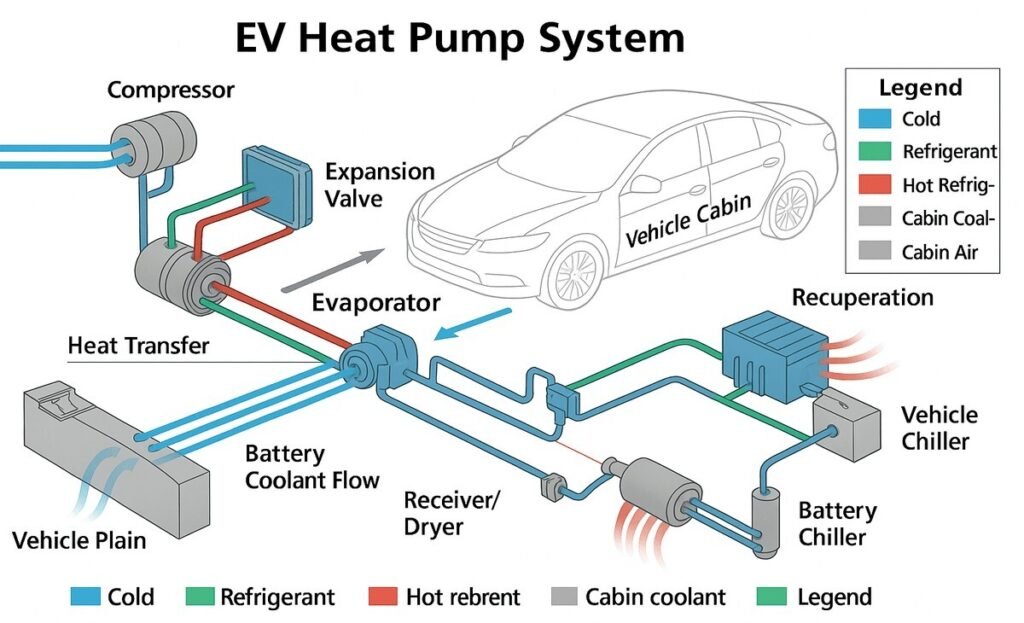
- Saves 10-30% range compared to cars without heat pumps
- Faster cabin warming when you start your trip
- Works in temperatures from -30°C to 60°C
Cars with Heat Pumps Available in India:
- BYD Atto 3 ✅
- Mahindra XEV 9e ✅
- Tesla Model Y ✅
- Hyundai Kona Electric ✅
- Kia EV6 ✅
Battery Preconditioning – Start Warm, Stay Efficient
This feature lets you warm up your car’s battery while it’s still plugged in.
Why This Matters:
Your car uses grid electricity instead of battery power for warming
15-20% better efficiency when you start driving
Faster charging at public stations because the battery is already warm
All-Wheel Drive (AWD) for Mountain Roads
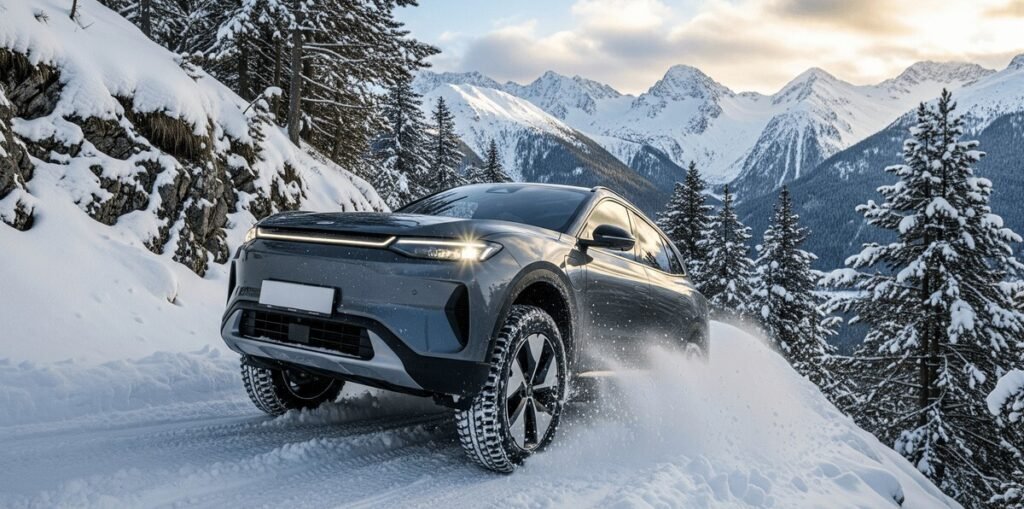
If your family loves hill station trips, AWD gives you:
- Better traction on wet and slippery roads
- Improved stability during sudden weather changes
- Confidence on steep mountain roads
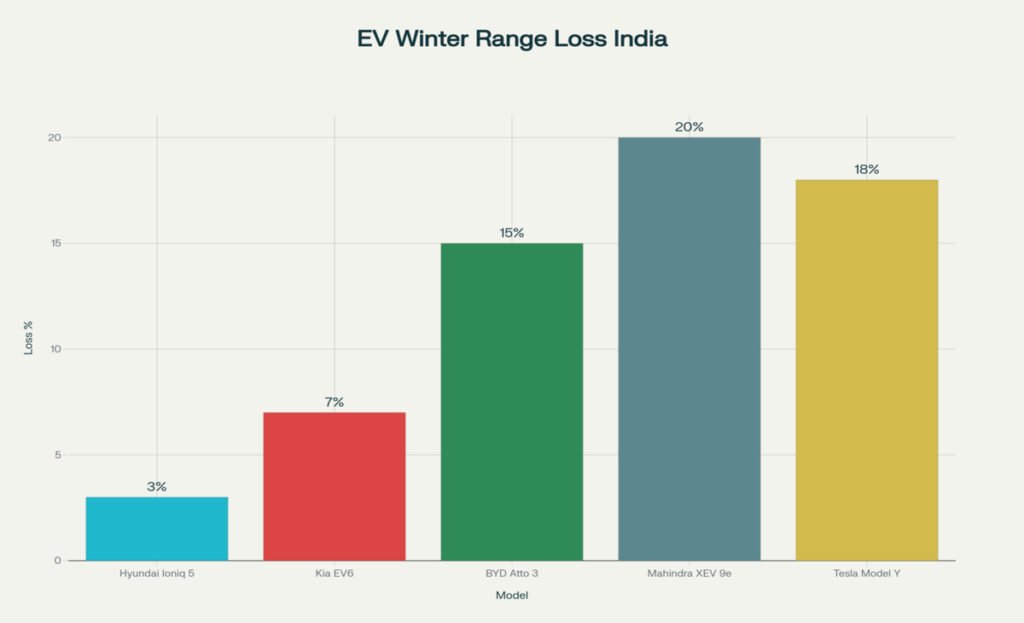
Winter range loss comparison showing the best electric cars for winter driving in India, with heat pump availability highlighted
Top 5 Best Electric Cars for Winter Driving in India
1. Hyundai Ioniq 5 – The Winter Champion
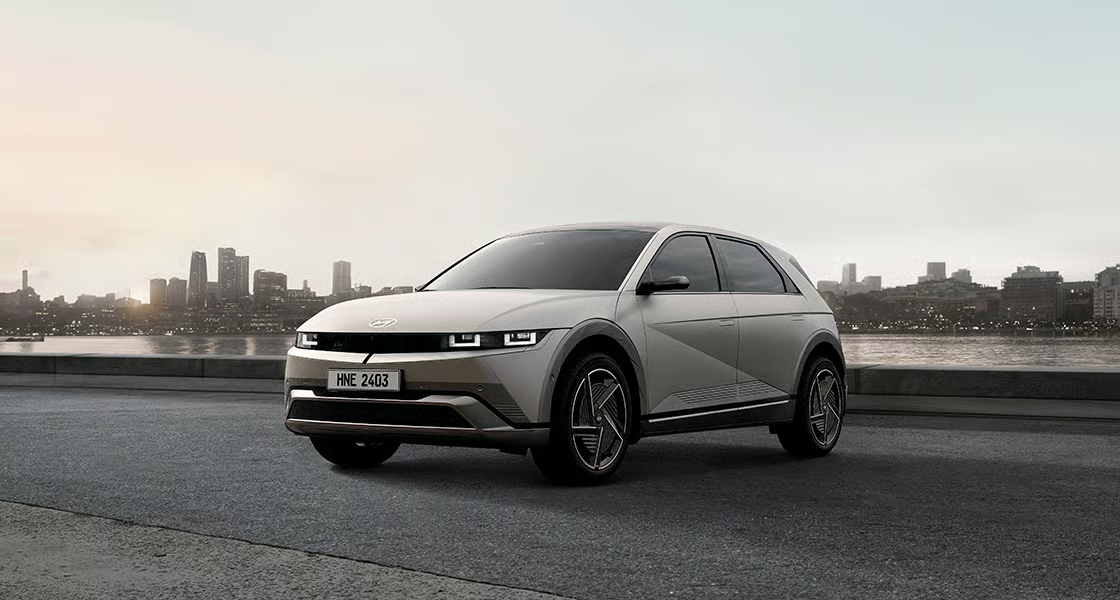
Price: ₹46.05 lakh
Winter Range Loss: Only 3% – Best in class!
Winter Range: 612 km
Why It’s Perfect for Indian Families:
- Minimal range loss – You’ll barely notice winter’s impact
- Ultra-fast charging – 16 minutes from 10-80%
- An advanced heat pump system designed for efficiency
- Snow mode for mountain driving
- Spacious interior perfect for family luggage
Best For: Families who frequently travel long distances and want premium features.
2. Kia EV6 – The All-Weather Performer
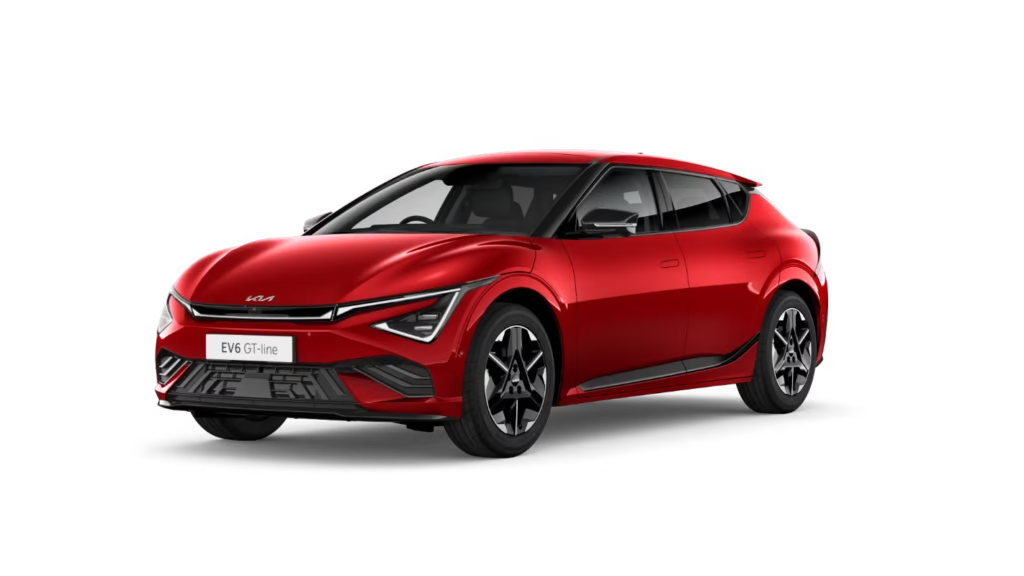
Price: ₹65.97 lakh
Winter Range Loss: 7%
Winter Range: 708 km
Family-Friendly Features:
- Excellent winter performance with minimal range loss
- All-wheel drive available for mountain trips
- Vehicle-to-Load function – Use your car as a power bank during camping
- Premium interior with heated and ventilated seats
Best For: Tech-savvy families who want the latest features and excellent winter capability.
3. BYD Atto 3 – The Smart Choice for Most Families
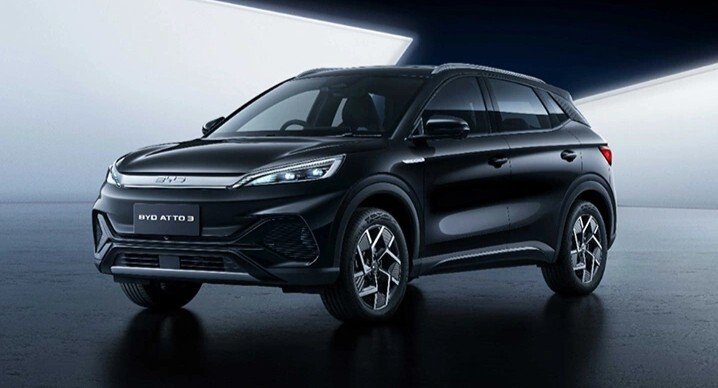
Price: ₹24.99 lakh
Winter Range Loss: 15%
Winter Range: 443 km
Why Families Love It:
- Excellent value for money with heat pump technology
- Wide temperature operation (-30°C to 60°C)
- A 20% range increase in winter compared to cars without heat pumps
- Rotating 12.8-inch touchscreen – kids will love this feature
- Strong safety features with a 360-degree camera
Best For: Budget-conscious families who still want good winter performance.
The BYD Atto 3 electric SUV front-side view highlights its modern design and suitability for winter driving.
4. Mahindra XEV 9e – The Indian Winter Specialist
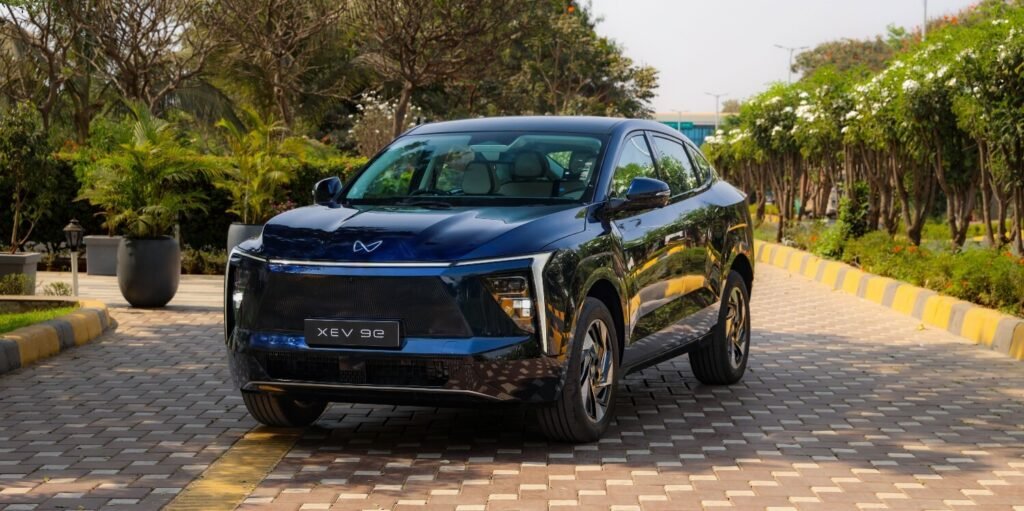
Price: ₹21.90 lakh
Winter Range Loss: 20%
Winter Range: 525 km
Perfect for Indian Conditions:
- Snow mode is specifically designed for winter driving
- Semi-active suspension adjusts to road conditions in 15 milliseconds
- 456 km real-world winter range tested across Indian cities
- Made for Indian roads with good ground clearance
Best For: Families who prioritise value and want a car designed specifically for Indian conditions.
5. Tesla Model Y – The Premium Winter Experience
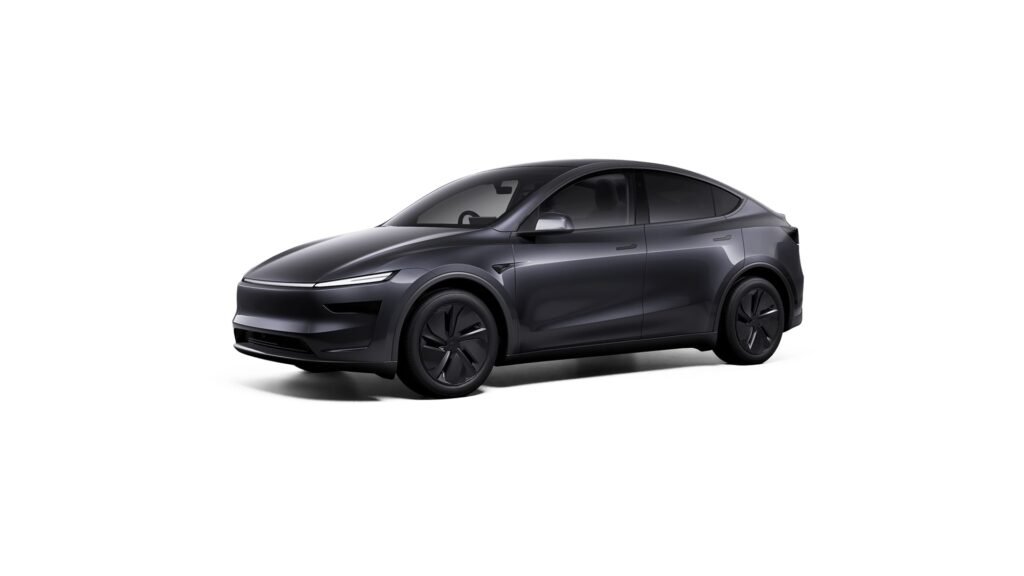
Price: ₹59.89 lakh
Winter Range Loss: 18%
Winter Range: 510 km
Advanced Winter Features:
- Octovalve heat pump system – Most advanced in the market
- Over-the-air updates continuously improve winter performance
- Advanced preconditioning via mobile app
- Supercharger network access for reliable winter charging
Best For: Tech enthusiasts who want the most advanced winter driving technology.
Winter Driving Tips That Every Indian EV Family Should Know
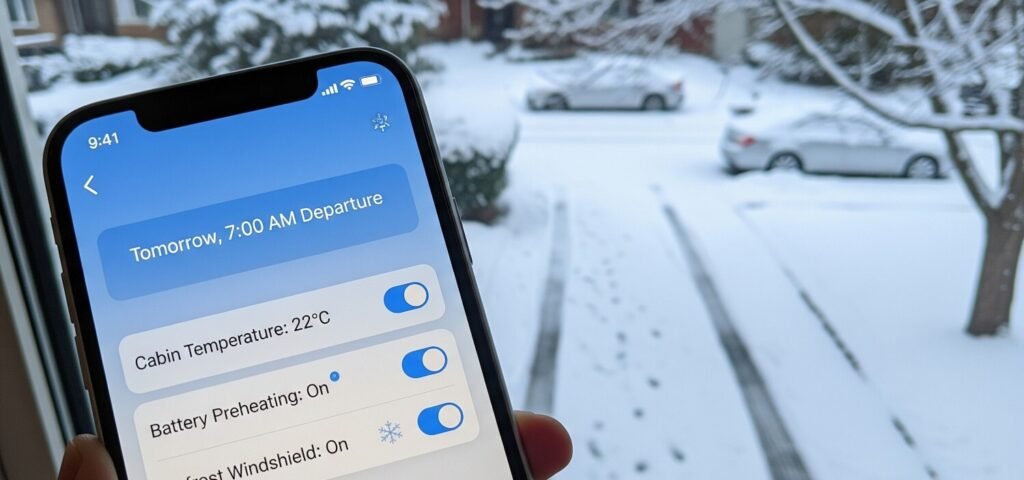
Before You Start Your Winter Trip
1. Precondition While Plugged In
Always warm up your car while it’s still charging at home.
How to do it:
- Set departure time using your car’s app
- Start preconditioning 20-30 minutes before leaving
- This saves 15-20% battery power for your trip
2. Plan Your Charging Stops
Winter reduces both range and charging speed.
Smart planning tips:
- Charge to 80% before starting long trips
- Keep the battery above 20% during winter travel
- Add 30% extra time for public charging stops
During Your Winter Drive
3. Use Smart Heating Strategies
Instead of heating the whole cabin:
- Use seat heaters first – They consume less energy
- Use a heated steering wheel if available
- Set the cabin temperature 2-3°C lower than the normal comfort level
4. Drive in Eco Mode
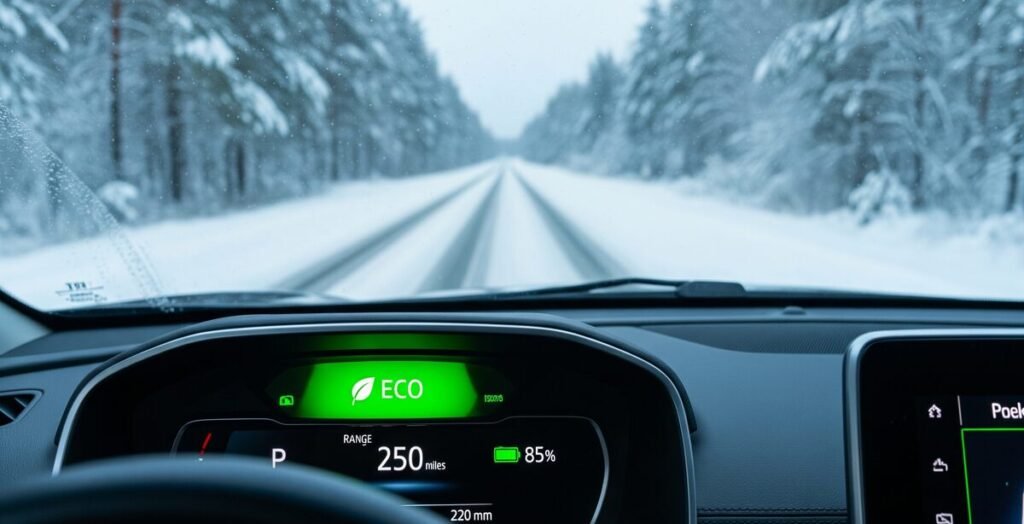
Benefits for winter driving:
- Better energy management in cold conditions
- Optimised power delivery for maximum efficiency
- Extended range when you need it most
Price vs winter performance analysis showing value-for-money electric vehicles for Indian families, with safety ratings and heat pump availability
Tire Care for Winter EV Driving
5. Check Tire Pressure Monthly
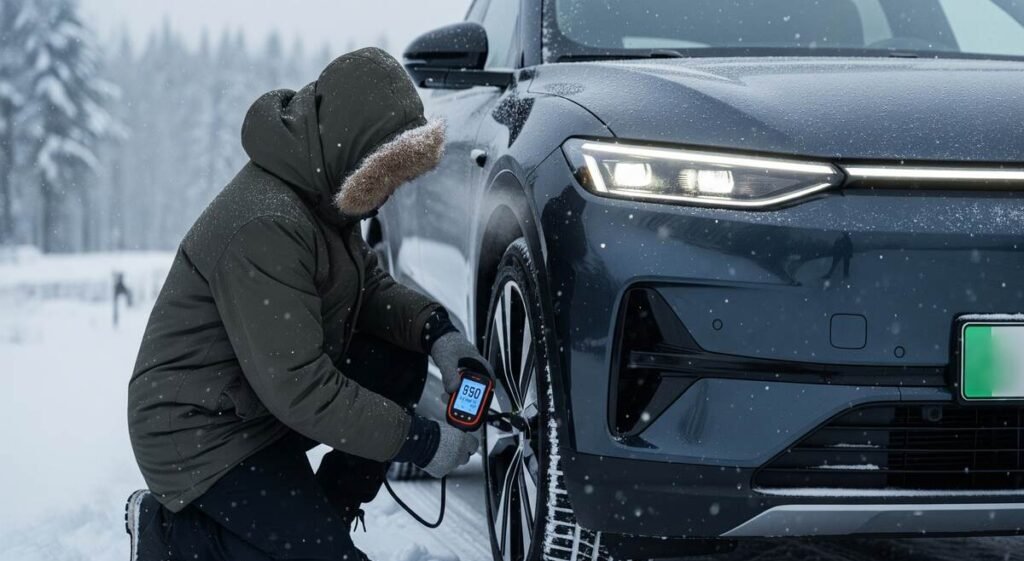
Cold air causes tire pressure to drop by 1 PSI per month.
Why this matters for EVs:
- Low tire pressure reduces range by 3-7%
- Affects traction on wet winter roads
- Increases tire wear, which is already higher in EVs
6. Consider All-Season or Winter Tires
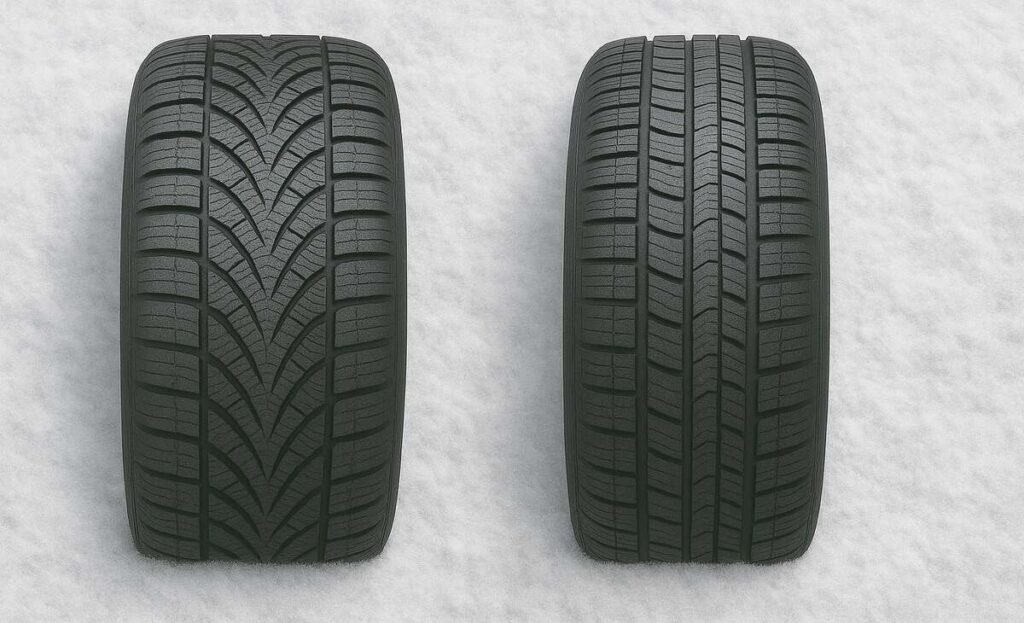
For families who frequently drive in hills:
- Better grip on wet roads during the monsoon and winter
- Improved safety during sudden weather changes
- Better performance than summer tires below 15°C
Charging Your EV During Indian Winters
Home Charging Strategy
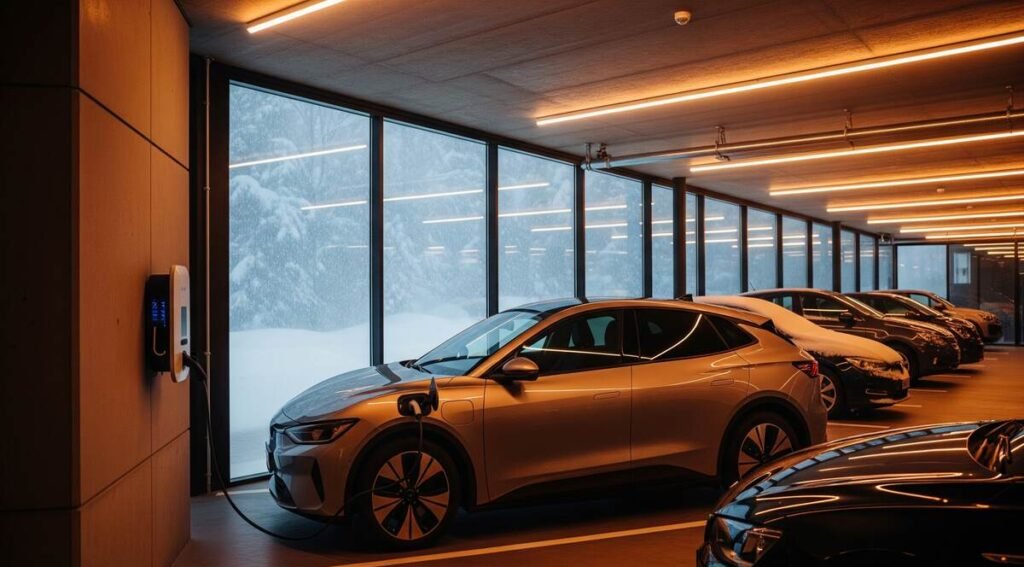
Best Practices:
- Charge indoors whenever possible (garage/covered area)
- Schedule charging to complete just before you leave
- Install a 7.2kW or 11kW charger for faster home charging
Public Charging in Winter
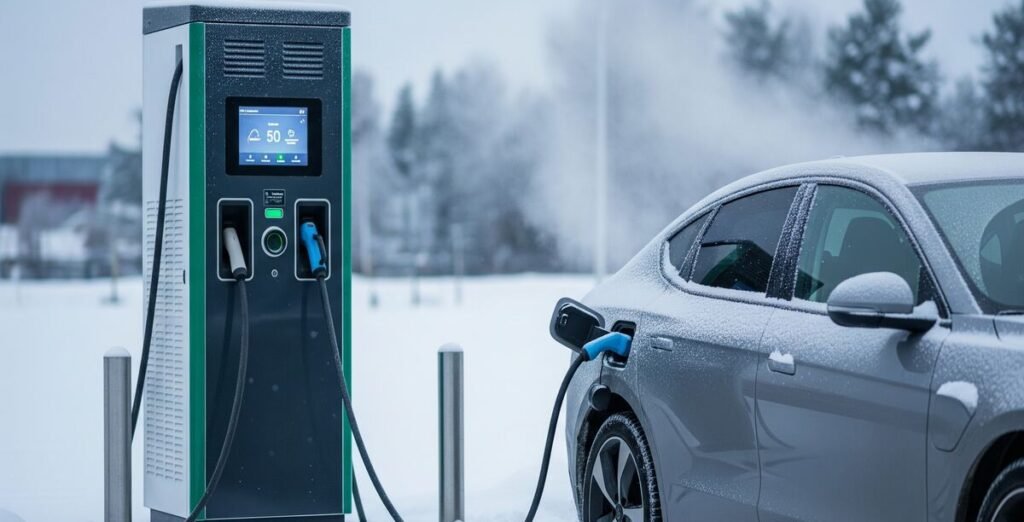
What to Expect:
- 20-30% longer charging times when the battery is cold
- Some chargers may not start immediately – this is normal
- The battery needs to warm up first before accepting the full charge rate
Pro Tips:
- Drive for 15-20 minutes before reaching a fast charger
- Use in-car navigation to charge stations – this precondition charges the battery automatically
- Carry backup charging options like portable chargers for emergencies
Safety Features That Matter in Winter
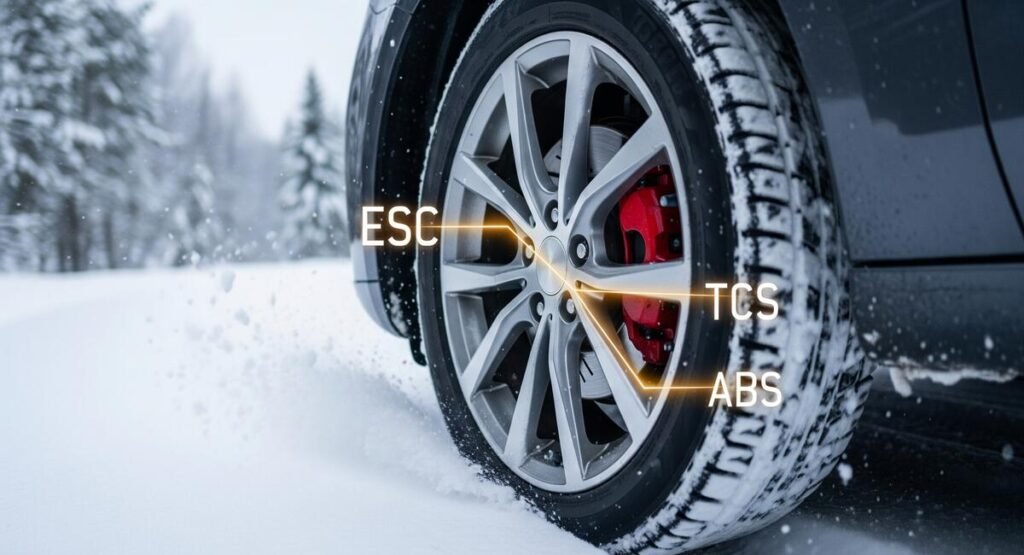
Electronic Stability Control (ESC)
How it helps:
- Prevents skidding on wet or icy roads
- Maintains vehicle control during sudden manoeuvres
- Essential for mountain driving, where road conditions change quickly
Traction Control System (TCS)
Benefits for Indian winters:
- Prevents wheel spin during acceleration on wet surfaces
- Maintains grip on loose gravel or muddy roads
- Helps during hill starts in challenging conditions
Anti-Lock Braking System (ABS)
Critical for winter safety:
- Prevents wheel lockup during emergency braking
- Allows steering control even during hard braking
- Reduces stopping distance on slippery surfaces
Real-World Winter Range: What Indian Families Get
Based on actual testing data from Indian conditions:
City Driving (Stop-and-Go Traffic):
- Tata Nexon EV: 280-300 km in winter
- MG ZS EV: 290-320 km in winter
- BYD Atto 3: 380-420 km in winter
- Mahindra XEV 9e: 420-450 km in winter
Highway Driving (Delhi to Manali type trips):
- With heat pump cars: 15-20% range reduction
- Without heat pump cars: 25-35% range reduction
Mountain Driving:
- Expect 20-30% more energy consumption due to elevation changes
- Regenerative braking helps during descents
- Plan charging stops every 200-250 km for safety
Cost Analysis: Winter Efficiency vs Running Costs
Electricity Costs During Winter
Even with reduced efficiency, EVs remain much cheaper than petrol cars:
Per km costs in winter:
- Tata Nexon EV: ₹1.2-1.5 per km
- BYD Atto 3: ₹1.5-1.8 per km
- Mahindra XEV 9e: ₹1.3-1.6 per km
Compare with petrol cars:
- Petrol SUV (10 kmpl): ₹10-12 per km
- Even in winter, EVs cost 80-85% less to run
Maintenance During Winter
EV advantages:
- No engine oil changes needed, regardless of temperature
- No coolant system issues like in petrol cars
- Brake pads last longer due to regenerative braking
Winter-specific maintenance:
- Check tire condition more frequently
- Clean the charging port if driving in dusty conditions
- Battery health check once a year
Common Winter EV Myths Busted
Myth 1: “EVs Can’t Handle Cold Weather”
Reality: Modern EVs are tested in temperatures as low as -40°C.
Proof: Norway, one of the coldest countries, has 80%+ EV adoption.
Myth 2: “EV Batteries Die in Winter”
Reality: Winter range loss is temporary.
Truth: Range returns to normal when temperatures rise.
Myth 3: “Charging Doesn’t Work in Winter”
Reality: All major EVs sold in India have battery heating systems.
Fact: Tesla owners regularly charge in -20°C conditions worldwide.
Your Winter EV Buying Decision Matrix
For Budget-Conscious Families (₹15-25 Lakh)
Best Choice: BYD Atto 3
- Heat pump technology
- Good winter performance
- Excellent features for the price
Alternative: Mahindra XEV 9e
- Designed for Indian conditions
- Good value proposition
- Snow mode for mountain driving
For Premium Family Experience (₹25-50 Lakh)
Best Choice: Hyundai Ioniq 5
- Best-in-class winter performance
- Minimal range loss
- Premium family features
Alternative: Tata Harrier EV
- Trusted Indian brand
- Good winter features
- Spacious for large families
For Tech Enthusiasts (₹50+ Lakh)
Best Choice: Tesla Model Y
- Most advanced winter technology
- Over-the-air improvements
- Supercharger network
Alternative: Kia EV6
- Excellent winter performance
- Premium features
- All-wheel drive available
Essential Winter EV Accessories for Indian Families
Must-Have Accessories
1. Portable Tire Inflator
- Winter air pressure drops require frequent adjustments
- ₹2,000-4,000 investment saves service visits
2. Emergency Charging Cable
- Type 2 to regular wall socket adapter
- Useful for remote locations with only a basic power supply
3. Car Cover
- Protects from morning frost
- Keeps the battery warmer when parked outside
Nice-to-Have Upgrades
4. All-Weather Floor Mats
- Protects the interior during wet winter conditions
- Easy to clean after muddy mountain trips
5. Dash Cam with Night Vision
- Records winter driving conditions
- Helpful for insurance claims if needed
Frequently Asked Questions
Yes. Modern EVs are validated for −30 °C to 60 °C, so Indian winters (5 °C – 15 °C) fall well inside their optimal operating range.
Expect a 15–25 % drop. Cars equipped with heat pumps usually see only 10–15 % loss, while those without can lose 25–35 %. The range returns to normal as temperatures rise.
The Hyundai Ioniq 5 leads with about 3 % range loss. Other strong performers are the Kia EV6 (≈7 %), BYD Atto 3 (≈15 %), and Tesla Model Y (≈18 %).
Absolutely. Many owners regularly visit Manali, Shimla, and similar destinations. Plan charging stops, pre-condition the battery, and pick an EV with features like a heat pump and AWD for the best experience.
Yes, all major Indian charging networks operate year-round. Charging can be 20–30 % slower in cold weather because the battery warms itself first—this is normal and safe.
Completely safe. EV charging hardware is sealed and tested for harsh conditions, including rain and snow, with multiple safety interlocks.
In most of India, all-season tyres suffice. If you frequently drive in hilly areas with frost, winter tyres below 15 °C can improve safety and efficiency.
Keep the state-of-charge between 20 % and 80 %, use pre-conditioning, park under cover when possible, avoid deep discharges, and drive regularly to keep the battery healthy.
Final Thoughts: Making the Right Choice for Your Family
Choosing the right electric car for winter driving isn’t just about the biggest battery or the lowest price.
It’s about finding the perfect balance of winter performance, family needs, and your budget.
For most Indian families, I recommend:
- BYD Atto 3 – Best value with excellent winter features
- Hyundai Ioniq 5 – Premium choice with minimal winter impact
- Mahindra XEV 9e – Great Indian option with winter-specific features
The electric future is here, and it’s winter-ready.
Your family doesn’t need to compromise on comfort, safety, or performance during the cold months.
Choose wisely, drive smart, and enjoy every winter adventure with your electric companion.
Remember: The best electric car for winter is the one that matches your family’s specific needs, budget, and driving patterns.
Ready to make the switch to electric?
Start by test-driving these top performers and experience firsthand how modern EVs handle Indian winter conditions.
Your next family adventure awaits – emission-free and winter-ready! ⚡🚗❄️
