

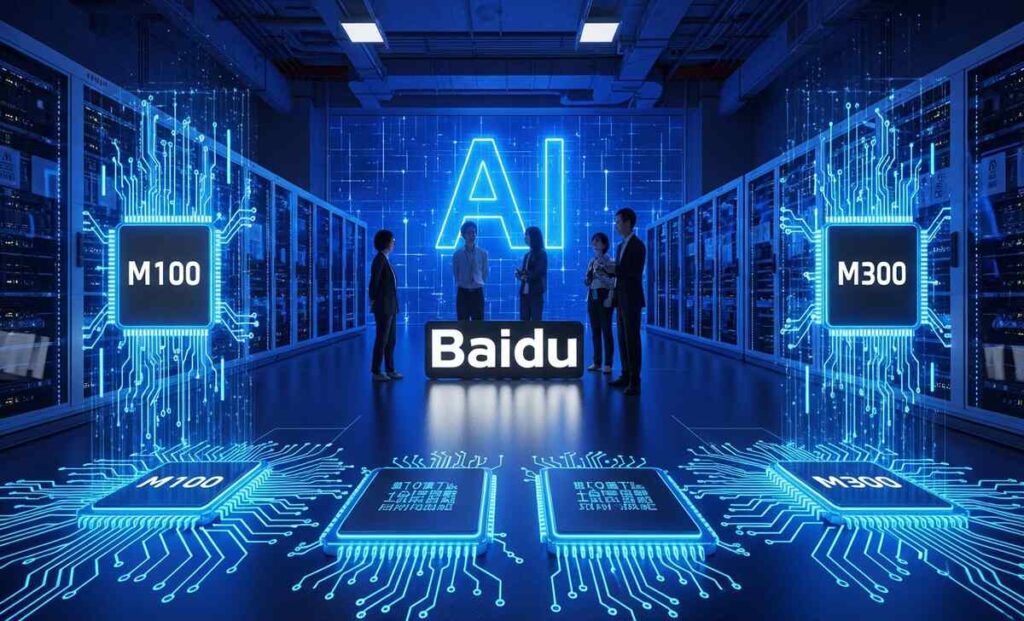

China’s tech giant Baidu made a headline splash at its Baidu World 2025 conference in Beijing. Baidu showed off two brand new AI processors, the M100 and M300. The announcement has come just as China faces rising tensions and chip export restrictions from the United States, pushing a national movement toward self-reliance and tech sovereignty.
What Did Baidu Launch?
Baidu announced two chips:
- M100: Focused on inference. It helps computers figure answers out super fast from AI-trained models. Launching early 2026.
- M300: Handles both training and inference. Training means teaching computers new stuff from lots of data. It’s set to arrive in 2027.
Both chips are designed by Kunlunxin, Baidu’s chip group. Baidu started making their own chips back in 2011, aiming to give Chinese companies cheaper and local computing options.
Why Does It Matter?
Since the US banned advanced American chips to China, local tech giants are competing to build domestic processors that can power AI and keep the country moving forward.
Chinese authorities have even asked big companies to stop using Nvidia chips, opening doors for brands like Baidu and Huawei. Recently, Huawei surprised the market with their CloudMatrix 384 system. It packs 384 Ascend 910C chips, and some experts say it’s more powerful than Nvidia’s latest supercomputers.
Baidu’s Supernodes—What Are Those?
Alongside chips, Baidu revealed new supernode platforms called Tianchi 256 and Tianchi 512. These connect hundreds of chips for even bigger, high-speed computing jobs.
- Tianchi 256: Made of 256 P800 chips, coming first half of 2026.
- Tianchi 512: Even bigger, with 512 chips, for the second half.
Supernodes are all about mixing lots of processors together to make megacomputers. That means China’s tech industry can handle huge AI tasks by themselves.
Ernie Model Gets a Major Upgrade
Baidu also upgraded its Ernie large language model. The newest Ernie can now process not just text, but images and videos too. That’s important because the future of search engines and online applications needs AI that understands and creates content across formats — from smart assistants to video moderation tech.
Baidu said Ernie will help firms compete globally, not just catch up but set new trends.
Tech Self-Sufficiency and Global Impact
- China sees chip innovation as central to economic security.
- The government wants big players to build their own, not just rely on imports.
- Baidu, Huawei, and others are fostering a growing ecosystem of domestic chip and AI tools.
- Companies like Alibaba and Tencent are moving in the same direction, making all of China’s major tech firms ready for advanced AI without depending on foreign supply chains.
What’s Next?
Baidu’s chip division Kunlunxin became a standalone company in 2021. It landed big orders from telecom giants like China Mobile just this year.
Stocks for Chinese tech surged as these AI developments brought new excitement for investors. Baidu’s advertising business might be cooling, but their push into AI and autonomous driving is setting up new growth.
(Source: marketscreener, cryptorank, medial)
