

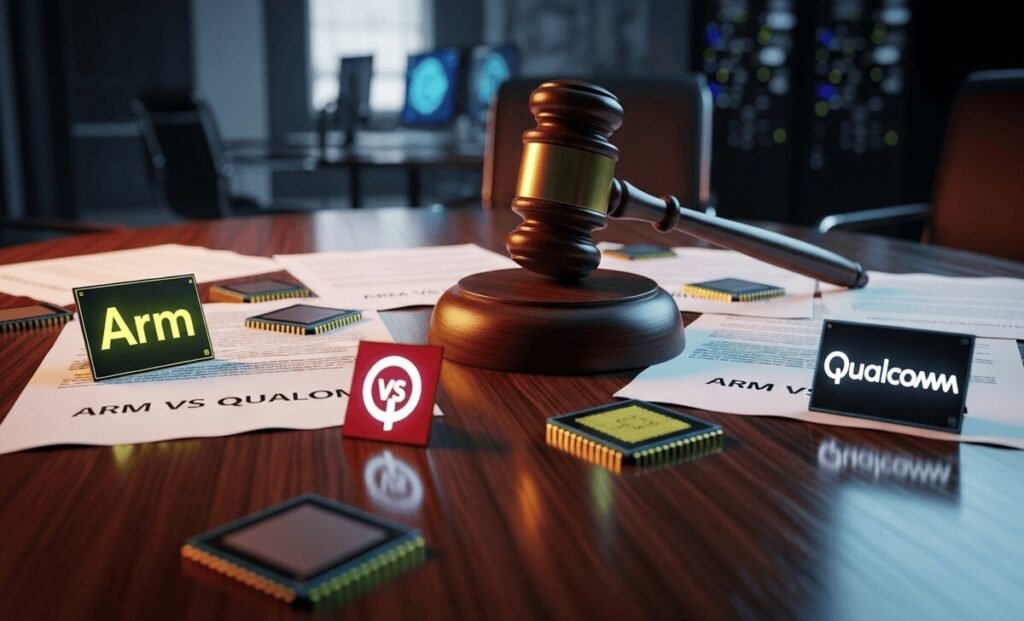

Arm Holdings announced Tuesday that it will appeal a U.S. District Court decision that upheld Qualcomm’s victory in a licensing dispute centered on chip designs from Nuvia, the company Qualcomm purchased back in 2021. The British chipmaker says it remains confident in its legal position and will immediately file paperwork to overturn the judgment handed down by Judge Maryellen Noreika in Delaware.
Court Backs Qualcomm Victory
The Delaware court’s decision follows a jury trial that wrapped up in December 2024, where jurors found that Qualcomm and its subsidiary Nuvia did not breach their licensing agreements with Arm. The jury reached verdicts on two of three counts but couldn’t agree on the third, which caused a mistrial on that particular claim. Arm had requested Judge Noreika throw out the verdicts where Qualcomm won or order a completely new trial, but she rejected both requests.
Qualcomm’s general counsel Ann Chaplin celebrated the ruling, stating that their “right to innovate prevailed” and expressing hope that Arm would return to fair practices when dealing with companies in the Arm ecosystem. The chipmaker described the outcome as a “full and final judgment” in its favor.
What Started The Legal Fight
The whole legal mess began after Qualcomm acquired Nuvia in 2021 for approximately $1.4 billion. Arm took issue with how Qualcomm used Nuvia’s technology, arguing that the licenses it granted to Nuvia couldn’t just transfer over to Qualcomm without getting proper permission first. The British company claimed this transfer violated the architecture license agreement, or ALA, that Nuvia originally had with Arm.
Qualcomm saw things differently, maintaining that its existing Architecture License Agreement already covered designs developed by subsidiaries like Nuvia. The chips at the center of this dispute are Qualcomm’s Oryon cores, which power the company’s Snapdragon X series processors found in devices like Microsoft Surface laptops.
Arm Pushes Back Hard
Even though the court sided with Qualcomm, Arm isn’t backing down one bit. The company issued a statement saying it “remains confident in its position” and will file an appeal immediately. This contradicts Qualcomm’s characterization of the judgment as completely final.
Interestingly, Qualcomm CEO Cristiano Amon told investors earlier in 2025 that Arm had no current plans to terminate Qualcomm’s Architecture License Agreement, which seems at odds with the aggressive legal tactics Arm has pursued. In 2024, Arm even went so far as to cancel the architecture license that let Qualcomm use its intellectual property for chip designs.
What Happens Next
The legal battle between these two semiconductor giants is far from over. Besides Arm’s planned appeal of this recent ruling, Qualcomm has filed its own separate lawsuit against Arm. Qualcomm’s counter-suit accuses the SoftBank-owned company of breach of contract and claims Arm has engaged in a “pattern of conduct seeking to hinder innovation” while trying to position its own products over long-standing partners.
That trial is expected to take place in March 2026, meaning this legal saga could drag on for at least another year and a half. The outcome matters a lot because Arm supplies essential technologies not just to Qualcomm but also to other major chip companies like Apple and Taiwan’s MediaTek.
Industry Impact And Stakes
The dispute highlights growing tensions in the semiconductor industry over licensing agreements and how they work when companies get acquired. Qualcomm’s ability to keep selling chips with Nuvia-developed designs affects a bunch of products already on the market, including laptops running on Snapdragon X processors.
For Arm, the case represents an attempt to maintain control over how its technologies get used and licensed across the industry. The company’s willingness to pursue an appeal despite losing at both the jury trial and in post-trial motions shows how much it believes the stakes matter.
Legal Arguments On Both Sides
Arm’s position centers on the idea that when Qualcomm bought Nuvia, it should have renegotiated licensing terms because Nuvia’s original licenses weren’t automatically transferable. The company even demanded that Qualcomm destroy the Oryon designs, claiming they violated Nuvia’s original Arm licenses.
Qualcomm countered by arguing its own separate license agreement with Arm already gave it the rights to use designs created by subsidiaries it acquired. The jury and judge both found this argument more convincing, at least for now.
Ann Chaplin emphasized that the court’s decision confirmed Qualcomm didn’t breach any agreements with Arm. She added that Qualcomm hopes Arm will move toward more competitive practices in the future.
Background On The Companies
Arm Holdings designs fundamental technologies that go into chips made by companies all over the world. Its architecture forms the basis for processors in smartphones, tablets, laptops, and increasingly other devices. Qualcomm ranks among Arm’s biggest customers, licensing its technologies to create chips for mobile devices and now computers.
Nuvia, the company at the heart of this dispute, was founded by former Apple chip engineers and focused on developing high-performance processors for data centers before Qualcomm acquired it. After the acquisition, Qualcomm pivoted Nuvia’s work toward creating the Oryon cores now used in its Snapdragon X chips for PCs.
The case was heard in the U.S. District Court for the District of Delaware, a jurisdiction that frequently handles major corporate disputes. Judge Maryellen Noreika oversaw the proceedings and issued the ruling that Arm now plans to appeal.
(Source: qualcomm)
