
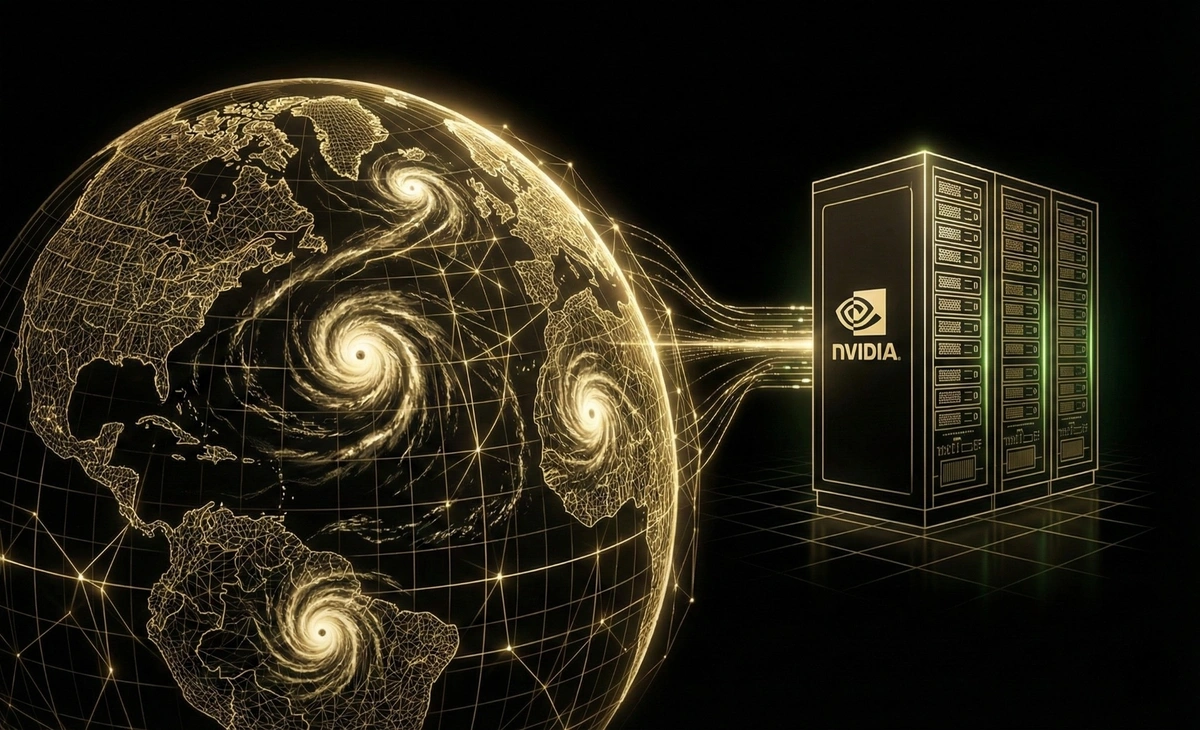

NVIDIA is changing how the world looks at the sky with its new Earth-2 family of open AI weather models. These tools turn raw weather data into fast forecasts that many teams can now run on their own systems.
For years, only big supercomputers could crunch complex weather math. That made detailed forecasts slow and costly in many regions. Now Earth-2 uses AI to cut this heavy work down to seconds on GPUs, so more groups can track storms, protect grids and plan for climate risk.
What NVIDIA announced
At the American Meteorological Society’s Annual Meeting in Houston, NVIDIA rolled out a full open stack for AI weather under its Earth-2 banner. The release covers pretrained models, libraries, and recipes that anyone can download and tune.
Key parts of the new Earth-2 open family are:
- Earth-2 Medium Range, built on a new Atlas architecture for 15‑day global forecasts across 70+ variables.
- Earth-2 Nowcasting, powered by the StormScope architecture, for zero‑ to six‑hour local storm and rainfall prediction at kilometer scale.
- Earth-2 Global Data Assimilation, using the HealDA architecture to turn noisy observation data into clean starting conditions for forecasts in seconds.
These sit alongside earlier open models like CorrDiff for downscaling and FourCastNet3 for fast, accurate medium‑range forecasts. Together they form what NVIDIA calls the first fully open, accelerated AI weather stack.
How the Earth-2 models work
Each Earth-2 model focuses on a different stage in the weather pipeline. When combined, they form an end‑to‑end AI system that can rival or beat classic physics‑based runs while using less compute.
- Earth-2 Medium Range predicts many variables such as temperature, wind, humidity and pressure up to 15 days ahead. On standard tests it outperforms leading open models on common forecast metrics.
- Earth-2 Nowcasting uses generative AI trained on satellite and radar data to learn how storm clouds grow, merge and decay, then produces minute‑scale, local predictions.
- Earth-2 Global Data Assimilation pulls in data from satellites, balloons and ground stations and builds a smooth 3D image of the atmosphere, ready to feed into forecast models.
Developers can also use CorrDiff to turn coarse global outputs into fine regional maps, up to 500x faster than old methods. FourCastNet3 offers fast ensembles that match or beat many classic models while needing far less runtime.
All of these can be trained and tuned with NVIDIA’s PhysicsNeMo framework, which is built for AI‑physics research at scale.
Who is using Earth-2 already
Even though the open family was just announced, a wide mix of users is already building on Earth-2. The list spans startups, national agencies, energy operators and insurers.
- Brightband runs Earth-2 Medium Range to issue daily global forecasts and says the open model helps others compare and improve quickly.
- The Israel Meteorological Service uses CorrDiff in production and plans to bring in Nowcasting to generate high‑resolution forecasts up to eight times a day with about 90% less compute time at 2.5‑km resolution.
- Taiwan’s Central Weather Administration, The Weather Company and the U.S. National Weather Service are testing Earth-2 models for severe weather and workflow upgrades.
In energy and grid operations:
- TotalEnergies is evaluating Nowcasting to improve short‑term risk decisions where minutes matter.
- Eni is testing FourCastNet and CorrDiff for downscaled, probabilistic forecasts weeks ahead for gas demand and weather.
- GCL in China is using Earth-2 for solar power prediction, reporting better accuracy at lower cost than traditional tools.
- Southwest Power Pool, with Hitachi, uses Nowcasting and FourCastNet3 for intraday and day‑ahead wind forecasting to support grid reliability.
In financial risk and insurance:
- S&P Global Energy applies CorrDiff to translate climate data into local risk signals.
- AXA uses FourCastNet to generate thousands of synthetic hurricane cases to test models and benchmark methods.
Why this open stack matters
Weather is now a core input for farming, energy, logistics, health and finance. Faster, cheaper, more local forecasts can change decisions every day in these fields.
NVIDIA’s move is important for a few reasons:
- Open access: Models, data and code are being made available through Earth2Studio, Hugging Face and GitHub, so teams do not need to start from scratch.
- Lower barrier: AI replaces huge CPU supercomputer runs with GPU‑powered pipelines, so smaller nations and startups can deploy serious forecasting systems.
- End‑to‑end AI: With HealDA, Medium Range and Nowcasting linked together, users can explore a full AI forecast chain instead of mixing many separate tools.
- Ecosystem links: Earth-2 can also integrate open models from ECMWF, Microsoft, Google and others, which supports a broader weather AI community.
Alongside other model families like Nemotron, Cosmos, Isaac GR00T, Alpamayo and Clara, Earth-2 shows how NVIDIA is building domain‑specific open AI stacks for different industries.
How to get started with Earth-2
Developers and researchers who want to test these models can pull them from several channels. Depending on needs, they can run quick demos, build local fine‑tuned versions or integrate Earth-2 into existing pipelines.
- Explore Earth-2 Medium Range and Nowcasting via the Earth2Studio project on GitHub.
- Download ready‑to‑use weights from NVIDIA collections on Hugging Face.
- Use PhysicsNeMo for custom training and scaling experiments.
- Follow NVIDIA’s technical guides and tutorials that show Earth-2 setups in a few minutes.
Global Data Assimilation is expected to roll out later this year, which will complete the fully open AI pipeline for many users.
(Source: nvidia)

Leave a Reply