
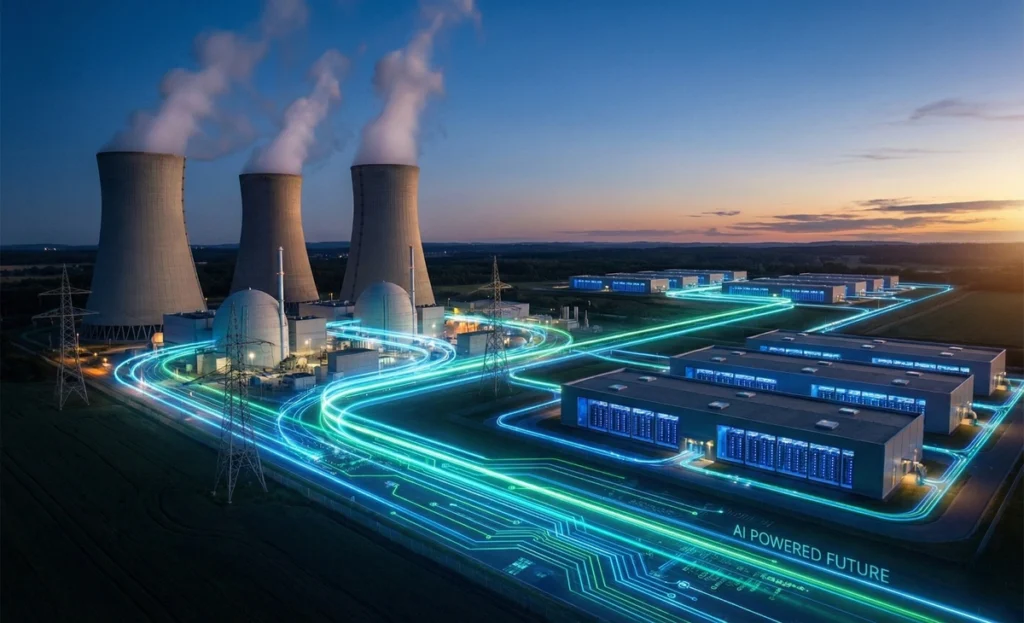

Meta Platforms has agreed to buy power for 20 years from three Vistra Corp nuclear plants: Perry and Davis‑Besse in Ohio, and Beaver Valley in Pennsylvania. The social media and AI giant will purchase about 2.176 gigawatts of nuclear energy and capacity from these operating sites, plus another 433 megawatts from uprates and equipment upgrades that lift the plants’ output.
The Vistra agreements effectively extend the commercial life of all three units while financing planned improvements that push more carbon‑free electricity onto the regional grid. Meta expects deliveries from Vistra to begin later in 2026, providing firm baseload power for its expanding data centers in the U.S. heartland as new AI clusters come online.
Key points from the Vistra deals:
- 3 existing reactors: Perry, Davis‑Besse (Ohio), Beaver Valley (Pennsylvania)
- ~2.176 GW contracted capacity, plus ~433 MW from upgrades
- 20‑year power purchase agreements focused on baseload supply
Oklo and TerraPower advanced reactors enter Meta’s AI roadmap
Beyond existing plants, Meta will help fund and offtake power from advanced nuclear projects led by Sam Altman‑backed Oklo and Bill Gates‑backed TerraPower. Oklo plans an “advanced nuclear technology campus” in Pike County, Ohio, targeting roughly 1.2 GW of capacity using small modular reactor designs tuned for data center loads.
Meta’s agreement with TerraPower centers on Natrium reactors, which combine a fast reactor with integrated energy storage to flex around grid demand. The deal supports two Natrium units delivering up to 690 MW as early as 2032 and reserves rights to energy from up to six additional units, bringing potential Natrium capacity to 2.8 GW plus roughly 1.2 GW of storage.
Planned advanced nuclear capacity under Meta’s deals:
- Oklo campus: ~1.2 GW targeted for Pike County, Ohio
- TerraPower Natrium: 690 MW from first 2 units, rights up to 2.8 GW total
- Delivery window: early 2030s, aligned with AI capacity build‑out
Why Meta is betting on nuclear for AI power
Meta is making this nuclear push because AI infrastructure is power‑hungry and needs reliable, 24/7 supply that does not blow up carbon footprints. Data center electricity demand in the U.S. is forecast to surge over the decade as larger language models, recommendation systems and generative AI run constantly in the cloud.
Company executives say nuclear offers firm, zero‑direct‑emission power that complements wind and solar and avoids the volatility of gas markets. In a corporate statement Meta argued that these agreements make it one of the biggest private nuclear energy buyers in U.S. history and are critical to securing America’s leadership in AI infrastructure.
Benefits Meta is targeting:
- Round‑the‑clock clean baseload for AI workloads
- Lower long‑term emissions versus fossil‑heavy grids
- More predictable energy costs over 20‑year horizons
Jobs, grid impact and regional politics
The nuclear package is designed to create thousands of skilled jobs in construction, operations and supporting services around the Ohio and Pennsylvania sites. Keeping Perry, Davis‑Besse and Beaver Valley running with capital upgrades stabilizes employment at plants that have faced economic pressure in competitive power markets.
Officials in those states see the Meta‑Vistra‑Oklo‑TerraPower alignment as both an industrial policy win and a way to keep large tax‑paying facilities online while new clean‑energy subsidies evolve. At the grid level, the extra nuclear capacity, efficiency uprates and advanced reactors are expected to inject several gigawatts of firm power into PJM and neighboring markets, shoring up reliability as more intermittent renewables connect.
Local and grid‑level impacts:
- Plant life extensions and uprates in Ohio and Pennsylvania
- Construction and long‑term operations jobs tied to new reactors
- Added stability for regional grids under rising AI data center load
What this nuclear push means for big tech
Amazon, Alphabet and Microsoft have all signed their own nuclear or SMR‑linked power deals, but Meta’s combined 6.6 GW package now ranks among the largest single corporate nuclear commitments. Analysts see the move as a signal that big tech will increasingly underwrite both existing reactors and new designs to guarantee power for AI clusters before grid bottlenecks appear.
Financial markets reacted quickly: shares of Vistra and Oklo jumped in pre‑market trading after the agreements were disclosed, reflecting expectations of long‑term contracted revenue and validation of advanced reactor business models. For regulators and energy planners, Meta’s announcement adds pressure to streamline licensing paths for new nuclear technologies without diluting safety rules.
