
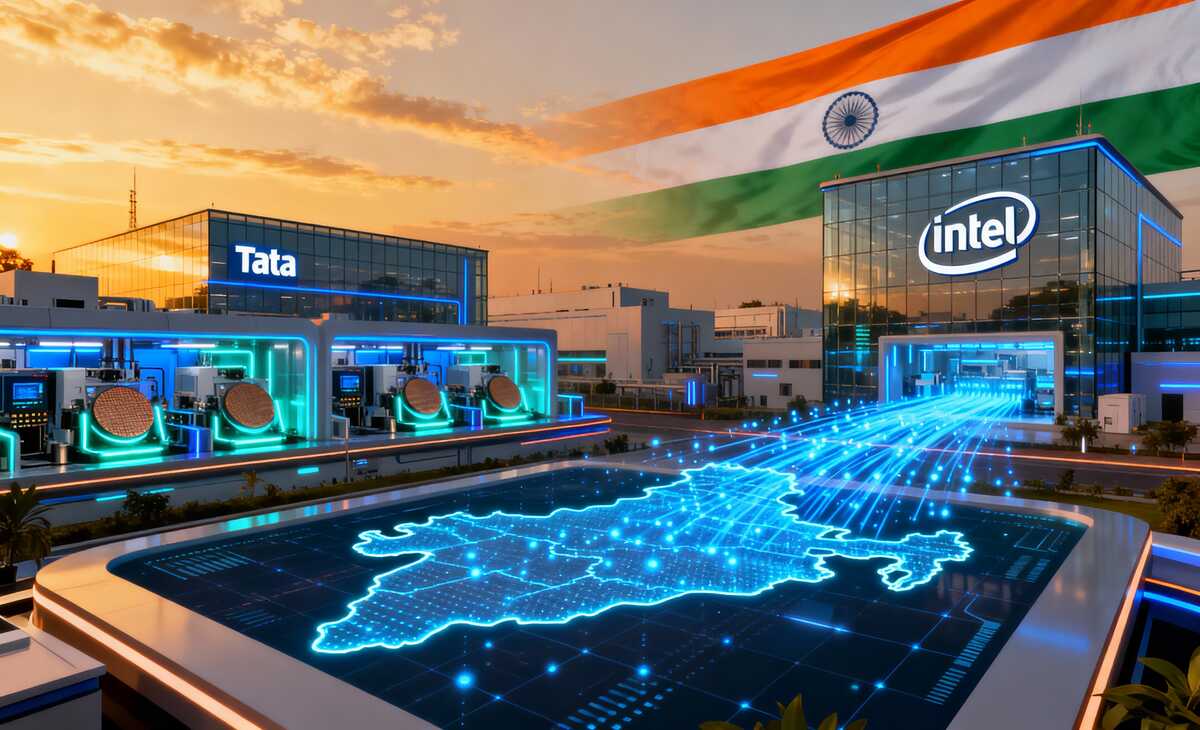

Tata Group and Intel have signed a strategic alliance to build a silicon and compute ecosystem centred in India, anchored by new fabs and packaging plants under Tata Electronics.
The agreement, framed as a Memorandum of Understanding on 8 December 2025, aims to make India a geo‑resilient base for semiconductors, systems manufacturing and next‑generation AI compute.
Key pillars of the alliance include:
- Manufacturing of select Intel products at Tata’s upcoming semiconductor fab in Dholera, Gujarat
- Advanced chip packaging and OSAT services at Tata’s facility in Guwahati, Assam
- Joint push to grow India’s AI PC, data centre and edge compute markets by 2030
What Tata brings to the table
Tata Electronics is already building India’s first large‑scale chip fabrication unit at Dholera, approved under the India Semiconductor Mission and expected to start operations around 2027.
Alongside the fab, Tata is setting up an OSAT facility in Assam, with combined investments across the two sites estimated at well over Rs 90,000 crore.
The company’s roadmap spans three big manufacturing legs.
- Electronics Manufacturing Services (EMS) for devices, boards and systems
- OSAT and advanced IC packaging, including system‑in‑package and flip‑chip based platforms
- A full‑scale semiconductor fab that can ship chips directly to OEMs in India and abroad
What Intel is betting on in India
Intel sees India as one of the fastest‑growing compute markets, driven by AI PCs, cloud workloads, connected cars and industrial automation.
By partnering with Tata as a first major customer for the new Indian fab and OSAT sites, Intel gains a local manufacturing and packaging base closer to end users.
Under the MoU, Intel and Tata plan to explore:
- Local manufacturing and packaging of Intel products tailored for Indian demand
- Advanced packaging options in India to support high‑performance AI and HPC chips
- Rapid scaling of AI PC reference designs using Tata’s EMS network and Tata Group distribution reach
Why this matters for India’s chip ambitions
New Delhi has been pushing hard to move from chip design and imports to domestic manufacturing, backed by a multi‑billion‑dollar semiconductor mission and incentive schemes.
Bringing Intel in as a headline anchor customer for Tata’s fabs and OSAT sites signals that India’s policy and industrial build‑out are starting to attract global tier‑one players.
This alliance also supports India’s goal of building a more resilient electronics supply chain away from single‑region dependencies.
With AI, 5G, automotive and industrial systems all demanding advanced packaging and high‑density compute, local capacity in Dholera and Guwahati can lower lead times and reduce import risk for domestic OEMs.
AI PCs, data centres and edge use cases
The two companies highlight AI PCs as an early focus, with India expected to rank among the world’s top five PC and compute markets by 2030.
By combining Intel’s AI compute reference designs with Tata’s EMS and distribution channels, the partnership aims to push AI‑ready laptops and desktops deeper into consumer and enterprise segments.
Beyond PCs, the same silicon, packaging and system capabilities feed into:
- Cloud and edge data centres handling generative AI and analytics
- Automotive platforms, especially EVs, needing high‑reliability chips
- Telecom and networking infrastructure for 5G and future wireless systems
How the Tata–Intel deal compares
| Dimension | Tata–Intel Alliance in India | Other India Semiconductor Moves | Global Context for Fabs |
|---|---|---|---|
| Core focus | Local Intel chip manufacturing, advanced packaging, and AI compute ecosystem | New fabs, OSAT facilities, and design units by multiple players | US, EU, and East Asia expanding fabrication for AI and HPC |
| India footprint | Dholera fabrication plant, Guwahati OSAT unit, EMS across Tata network | Other private projects and joint ventures under the India Semiconductor Mission (ISM) | High concentration in Taiwan, South Korea, the US, and Europe |
| AI opportunity target | AI PCs, data centers, edge computing, and industrial AI systems by 2030 | Mix of consumer, automotive, and telecom chips | Global AI chip demand across cloud, data center, and edge devices |
What to watch next
In the next few years, the big milestones to track will be construction progress at Dholera and Guwahati, along with firmed‑up product lines that Intel chooses to manufacture or package in India.
Regulatory clearances, incentive disbursements and ecosystem partners—EDA vendors, equipment suppliers, materials players—will also shape how quickly the Tata–Intel roadmap turns into volume shipments.
If timelines hold, India could see its first wave of locally made Intel chips shipping from Tata facilities before the end of the decade, directly supporting AI, cloud and automotive platforms built in the country.
For students, engineers and electronics startups, this could mean closer access to manufacturing, packaging R&D and high‑value jobs across the semiconductor stack.
(Source: tataelectronics)

Leave a Reply