
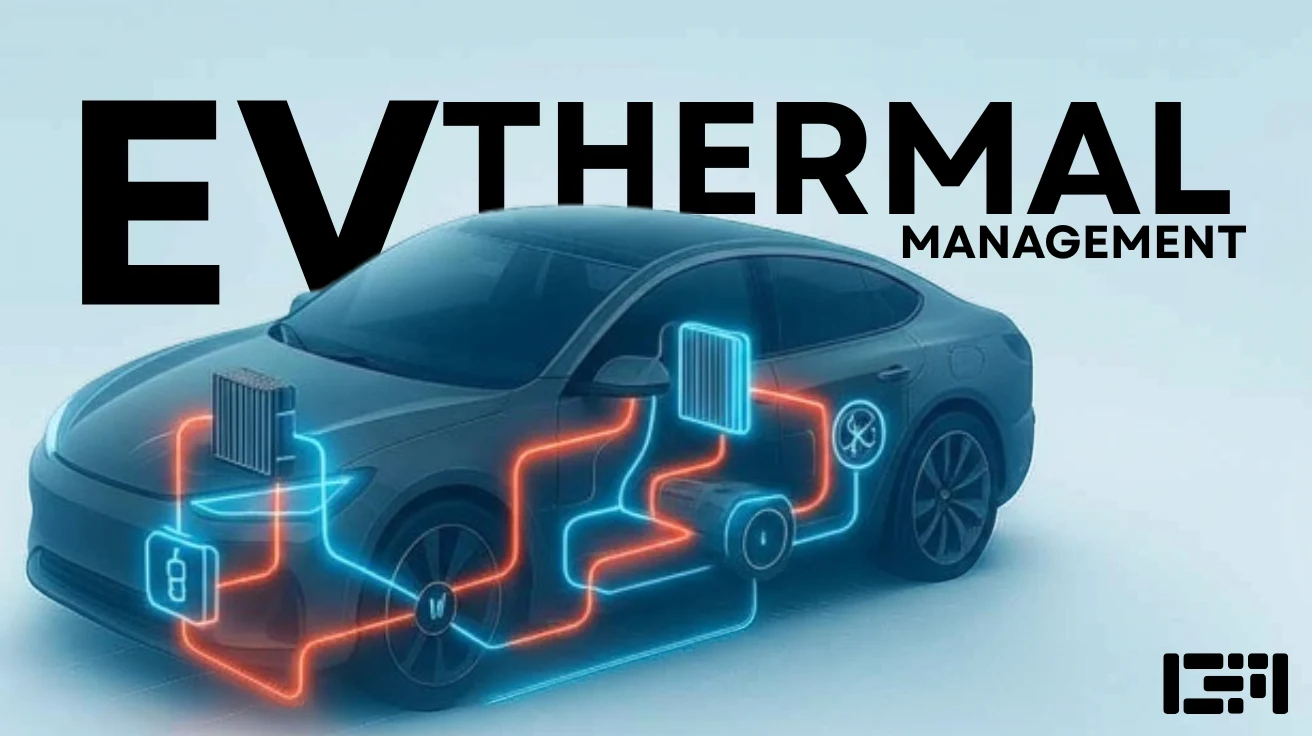

What if your EV could shrug off 40°C heatwaves and –20°C winters—without losing a single mile of range?
That’s the promise of next‑generation EV thermal management. By combining liquid‑cooling loops, heat‑pump heating, precision sensors, and AI‑driven controls, modern systems deliver:
- Faster Charging: Aggressively cool the battery for rapid 150 kW+ charging with minimal cell stress.
- Consistent Performance: Maintain ideal temperatures—whether you’re sprinting on the highway or crawling in traffic.
- Enhanced Safety & Longevity: Prevent thermal runaway, slow battery aging, and extend pack life by years.
In this guide, you’ll explore exactly which cooling technologies matter most for today’s electric cars, how to compare air‑, liquid‑, refrigerant‑, and immersion‑based loops, and what design trade‑offs to watch for when choosing your next EV.
Why Thermal Management Matters
Every EV part has its own best temperature window. Go outside that window, and these issues appear:
- Range Loss: Batteries hold less energy when too hot or too cold.
- Slower Charging: High battery temperatures limit charging speed.
- Faster Aging: Heat accelerates wear, cutting pack life short.
- Safety Risks: Overheated cells may vent gas or, in rare cases, catch fire.
Good EV thermal management ensures:
- Consistent performance across climates.
- Quicker charging with less stress on cells.
- Longer battery and motor lifespan.
- Peace of mind through enhanced safety systems.
For both current and future EVs, managing temperature isn’t optional—it’s a must.
Core Components of an EV Thermal Management System
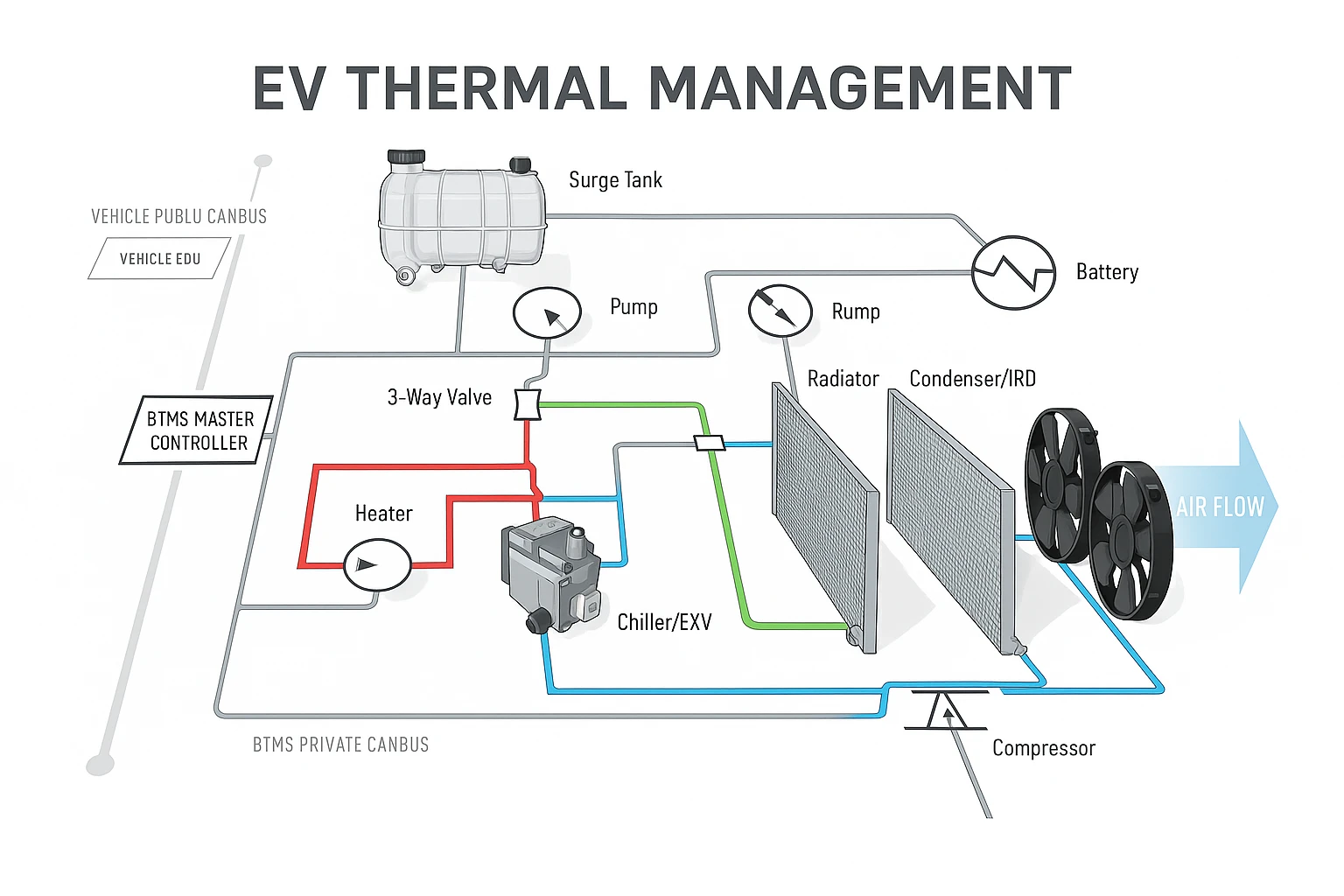
An effective EV thermal management system links several parts into one cooling and heating loop:
- Heat Exchangers
Metal elements that move heat between coolant and air or refrigerant. - Pumps & Fans
Devices that circulate coolant or air through the system. - Valves & Manifolds
Mechanisms that route flow to the battery, motor, or inverter as needed. - Sensors
Temperature probes placed at every critical point. - Control Unit (TCU)
Software brain that uses sensor data to adjust fans, pumps, and valves.
Each component works together to keep the thermal balance. A leak or sensor fault can throw the system off, so regular checks are vital.
Types of Thermal Management Systems
Below is a comparison table of the main thermal management system for electric vehicles:
| System Type | How It Works | Pros | Cons |
|---|---|---|---|
| Air Cooling | Fans push ambient air over battery or motor fins | Low cost, simple, light | Limited heat capacity, noisy |
| Liquid Cooling | Pumps circulate coolant through cold plates | High heat removal, uniform temps | More parts, higher cost |
| Refrigerant Cooling | Uses AC refrigerant loop with an extra evaporator | Very fast cooling, leverages AC system | Complex, risk of refrigerant leaks |
| Immersion Cooling | Submerges cells in dielectric fluid | Best heat transfer, passive safety | New technology, fluid management |
Air Cooling
Air cooling relies on ambient air drawn in by fans or vehicle motion. Fins or plates attached to the battery pack and motor dissipate heat into the passing air.
- Best For: Low-power EVs, compact city cars
- Pros:
- Few moving parts
- Low maintenance
- Cons:
- Struggles in very hot weather
- Noise from high-speed fans
Air cooling remains popular for budget models. But as battery capacity climbs, its heat removal limit becomes a drawback.
Liquid Cooling
Liquid cooling uses a pump to move coolant through a network of tubes and cold plates. These plates clamp directly onto cells, the inverter, or the motor housing.
- Best For: Mid-range to high-performance EVs
- Pros:
- Even temperature across components
- Efficient even at high loads
- Cons:
- More complex assembly
- Potential leaks require safeguards.
A typical liquid-cooled EV thermal management system loops through:
- Cold plates in the battery pack
- Heat exchanger (radiator) to dump heat
- Pump and reservoir to keep coolant moving
This approach is the industry standard for modern electric cars.
Refrigerant Cooling
Refrigerant cooling taps into the vehicle’s air conditioning loop. An extra evaporator sits inside the battery pack, letting the AC compressor cool batteries directly.
- Best For: EVs needing rapid cooldown in hot climates
- Pros:
- Very quick response to heat spikes
- Uses existing AC hardware
- Cons:
- Adds load to the AC system
- More complex control logic
When combined with a heat pump, a refrigerant-based system can also heat the pack in cold weather, improving winter range.
Immersion Cooling
With immersion cooling, each cell or module sits in a pool of dielectric (nonconductive) fluid. This fluid draws away heat uniformly across the entire pack.
- Best For: Ultra-fast charging EVs, high-power applications
- Pros:
- Best heat transfer rates
- Passive safety by equalizing cell temperatures
- Cons:
- Handling and sealing fluid is challenging.
- Emerging technology with fewer suppliers
Automotive innovators are exploring immersion cooling to push charging speeds beyond 350 kW without overheating.
Design Considerations for EV Thermal Management
Designing an effective EV thermal management system involves balancing many factors:
- Vehicle Power & Usage
High-power sports EVs need robust loops. City commuters may use simpler solutions. - Battery Chemistry & Layout
Lithium-ion variations (NMC, LFP) have different heat limits and ideal temps. - Climate Conditions
Extreme cold or heat strains any system. Multi-zone loops can adapt better. - Packaging & Weight
Cooling equipment adds mass and takes up space under the floor or trunk. - Energy Draw
Fans, pumps, and heat pumps consume kW that subtract from driving range. - Cost & Serviceability
Simpler systems cost less to build and maintain. Complex loops boost performance but raise price.
A thermal management system for electric vehicles must match the EV’s intended use. Luxury crossovers can justify weight and cost for smoother temps. Entry-level models often favor light, low-cost air cooling.
Common Challenges in EV Thermal Management
Even the best-designed systems face recurring hurdles:
- Extreme Temperatures
Thirty-plus-degree Celsius days or sub‑20°C nights push cooling and heating to their limits. - Fast Charging Heat
Charging at 150 kW or more pumps a lot of heat into cells in minutes. - System Failures
A pump or fan failure can leave cells running dangerously hot. - Energy Penalty
Keeping the pack warm in winter or cool in summer can cut range by 5–15%. - Complex Controls
Managing multiple loops and modes requires robust software and failsafes. - Manufacturing Variance
Slight assembly differences can change coolant flow and temperature profiles.
Addressing these challenges means designing redundancy, monitoring health, and optimizing control algorithms.
Solutions and Best Practices
To overcome thermal hurdles, engineers and OEMs use these tactics:
- Multi-Zone Cooling
Separate loops for the battery, motor, and power electronics. - Heat Pump Integration
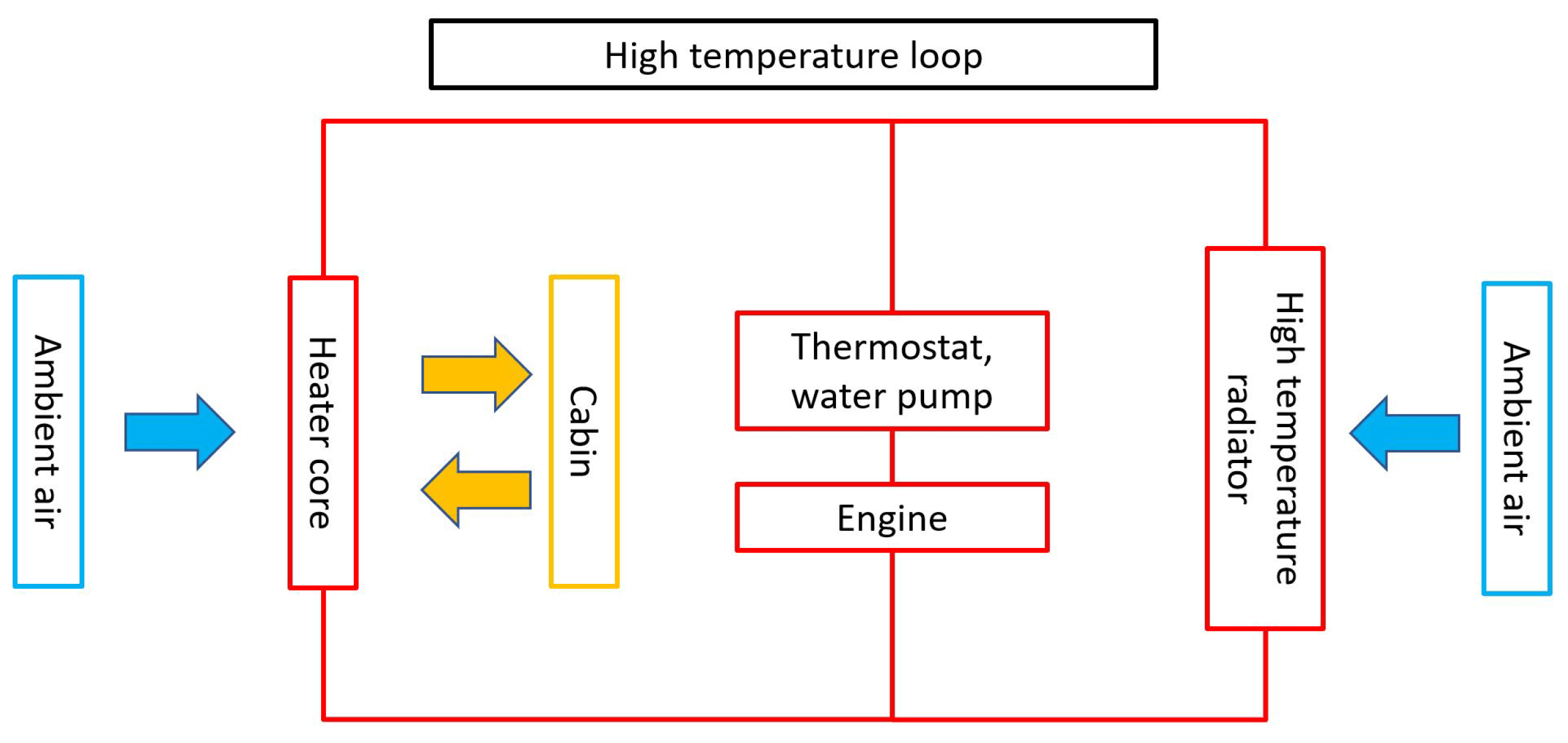
Use waste heat from the motor/inverter to warm the cabin or battery in cold weather. - Phase Change Materials (PCMs)
Incorporate materials that absorb peak heats and release them slowly. - Software Optimization
Predictive control uses route data, outside temperature, and driving style to pre-cool or pre-heat. - Redundancy & Failsafes
Dual pumps or backup valves keep critical loops alive if one component fails. - Active Air Shutters
Close or open vents to control airflow over radiators, reducing drag and saving energy. - High-Efficiency Components
Low-power controllers and high-efficiency pumps reduce the energy penalty of cooling.
Careful lab testing in environmental chambers, coupled with long-haul field trials, ensures the system meets real-world demands.
Future Trends in EV Thermal Management
The field evolves fast. These trends will shape tomorrow’s electric vehicle thermal management:
- Solid-State Batteries
With higher energy density but stricter temperature needs, thermal loops must be more precise. - AI-Driven Controls
Machine learning predicts heat generation from driver behavior and optimizes coolant flow in real time. - Advanced PCMs and Nano-Materials
New phase change composites and heat spreaders boost passive thermal buffering. - 3D-Printed Cold Plates
Micro-channel designs bring coolant closer to each cell, slashing thermal resistance. - Refrigerant Innovation
More eco-friendly refrigerants and low-GWP compounds improve battery AC systems. - Modular Cooling Units
“Plug-and-play “modules let OEMs quickly scale cooling capacity across different EV platforms. - Immersion+Hybrid Systems
Combining immersion cooling for high-power modules and liquid cooling for the rest enhances flexibility.
These innovations make future EV thermal management system designs lighter, smarter, and more efficient.
Case Study: Thermal Management in a Modern EV
Let’s look at a generic mid-size crossover EV using a sophisticated thermal management electric vehicle package.
Components:
- Dual liquid-cooling loops (battery & electronics)
- Integrated heat pump for cabin and battery heating
- Active grille shutters and variable-speed fans
- Thermal sensors in every module
Operation Highlights:
- Cold Start
The heat pump harvests inverter warm-up heat to warm the battery pack. - Normal Driving
Separate loops keep the battery at 30°C and the inverter at 50°C, ensuring peak efficiency. - Fast Charging
The refrigerant loop kicks in, dropping pack temperature by 10°C within 5 minutes. - High-Speed Run
Fans and radiators work harder, while software redirects coolant to the hottest zones first.
Results:
- Range retention above 95% in −10°C to 40°C climate tests.
- Charging to 80% SOC in 30 minutes with less than 1°C cell variation.
- Zero thermal-related service calls in 100,000 miles of fleet testing.
This case shows how combining multiple cooling strategies and smart controls maximizes performance, safety, and comfort.
ASCII Diagram: Multi-Loop Thermal Flow
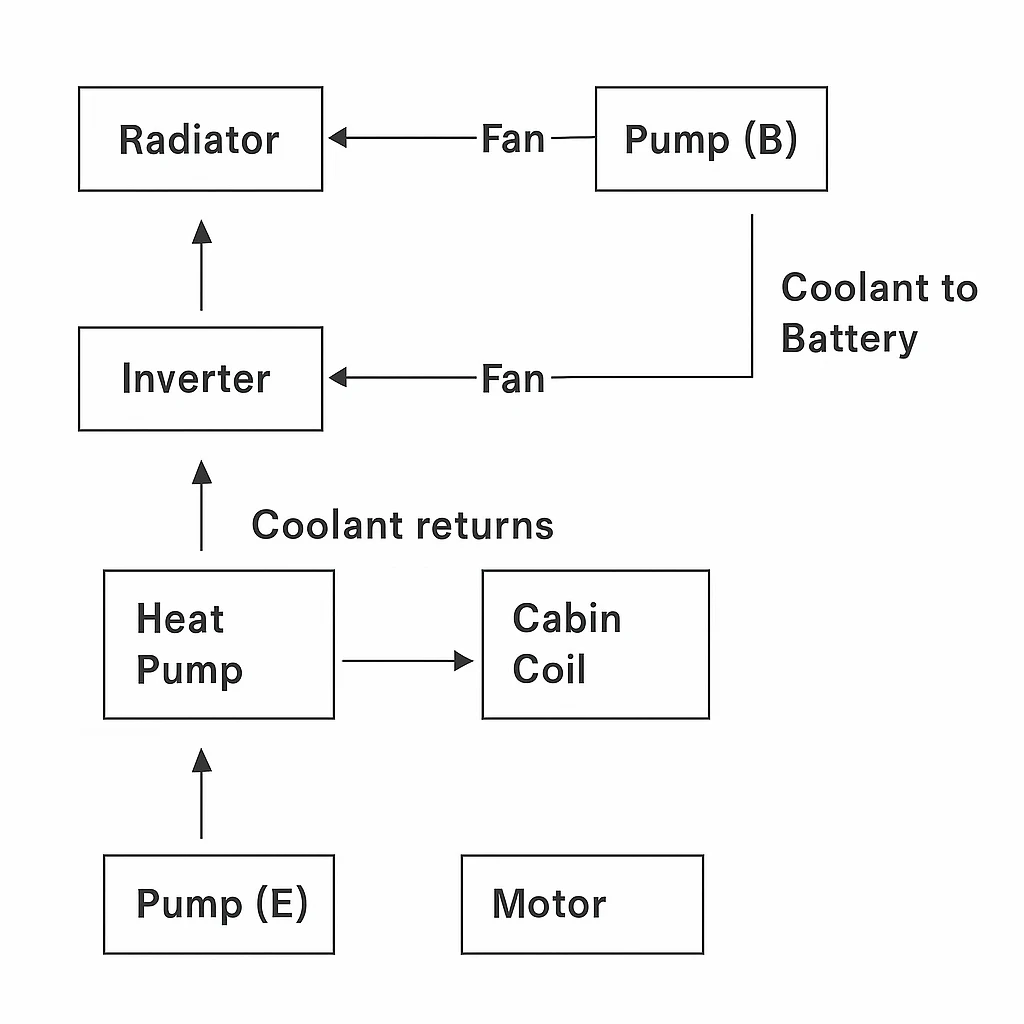
- Pump (B): Battery loop
- Pump (E): Electronics loop
- Fans: Adjust airflow over radiators/inverter
Current vs. Future Technologies
| Feature | Today’s Systems | Tomorrow’s Innovations |
|---|---|---|
| Cooling Medium | Water-glycol coolant, air | Dielectric fluids, nano-fluids |
| Control Logic | Rule-based, static setpoints | AI-driven, predictive |
| Thermal Buffering | Minimal PCMs, metal heat spreaders | Advanced phase change composites |
| Pack Heating | Resistive heaters or heat pumps only | Integrated waste-heat recovery loops |
| Charging Support | Up to 150 kW fast charging | 350 kW+ ultra-fast charging |
The content comes to a close.
EV thermal management is the unseen hero of every EV drive. From battery health to charging speeds and motor efficiency, good thermal design shapes the driving experience.
Today’s leading systems blend liquid loops, heat pumps, and refrigerant cooling with smart software. Tomorrow’s advances in AI control, immersion cooling, and new materials will push EV range and charging speeds even further.
For EV buyers and owners, understanding these systems helps you choose the right vehicle and maintain peak performance. As the market grows globally, innovations in EV thermal will keep your drive cool, safe, and reliable—now and into the future.

Leave a Reply